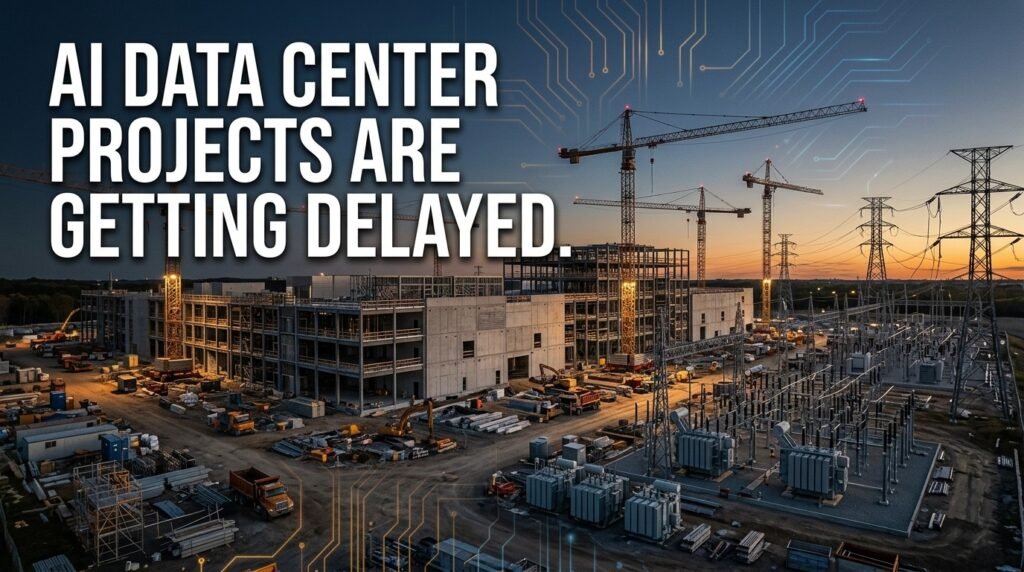

AI data centers are the large-scale, energy intensive facilities containing the computers networks, server house, GPUS house the servers, networking equipment. AI data centers require cooling systems to train and run Artificial Intelligence models. As demand for AI computing accelerates, developers are announcing data center projects faster than electricity grids, equipment supply chains, permits, and export rules can keep up.
As a result, many AI data center projects are being delayed around the world. The main causes are insufficient grid capacity, long lead times for electrical equipment, permitting and local opposition, and new U.S. restrictions on advanced AI chip exports.fortune+2
What Is an AI Data Center?
An AI data center is a specialized facility designed to support high-performance computing workloads. Unlike a standard cloud data center, an AI data center often requires thousands of advanced GPUs, high-density server racks, liquid or advanced air cooling, and very large amounts of electricity.
These facilities support AI model training, inference, cloud services, enterprise AI applications, and real-time digital services. Their rapid growth has created a major challenge: a data center can often be built in 18 to 24 months, but the transmission infrastructure, grid connections, and new power generation needed to operate it can take several years.
Why AI Data Center Projects Are Getting Delayed
1. Electricity Grid Capacity Is Falling Behind
The biggest delay in the projects of Data centers is the power factor. AI data centers consume enormous amounts of electricity, and many proposed sites are in regions where the local grid cannot deliver enough power on the required timeline.
Data center power demand is reportedly growing about 19% annually, while grid capacity is growing around 2%. Building new grid capacity is slow because it requires coordinated planning across generation, transmission lines, substations, permits, land rights, and equipment procurement.
2. Transformers and Grid Equipment Are in Short Supply
AI data centers need more than servers. They also need transformers, switchgear, high-voltage cables, cooling systems, backup generators, and substation equipment.
Supply chains for these components have become a major bottleneck. The research conducted by the Data Center found that the transformer leads to an average increase about 50 weeks in 2021 to roughly 120 weeks in 2024. Some large substations and generators set-up of transformers can take 18 months to 48 months to obtain.Allianz similarly reports growing shortages of transformers, switchgear, and high-voltage cables, with lead times extending to several years in some markets.
3. Permitting and Environmental Reviews Take Time
The data center development must obtain permission, constructions permits, environmental assessments, water use approvals and grind interconnection agreements. These processes can take more than a year particularly for new power substations or high voltage energy transmission lines.
Permitting is not just paperwork. In PJM’s January 2026 data, permitting accounted for 29% of milestone change requests for projects under construction or development, while supply-chain delays accounted for 23%
4. Communities Are Concerned About Power, Water, and Noise
AI data centers can create concerns about electricity prices, water consumption, environmental pollution which directly impact the nearby communities. These concerns can lead to public hearings, legal challenges, revised plans, or withdrawn approvals.
A recent example is a proposed £2 billion AI data center in Tonstad, Norway, where the regional state administrator revoked an approval after concerns that proper environmental impact assessment procedures had not been followed. The project may now face months of additional delay while authorities decide whether to seek fresh approva.
5. Construction Labor and Project Complexity
AI data centers are more complex than traditional office buildings. They require specialized electrical engineering, high-density cooling, redundant power systems, fiber connectivity, and coordination among utilities, contractors, chip suppliers, and cloud operators.
Bain estimates that constructing a 1-gigawatt data center typically takes one to four years, even on sites with existing power. Projects requiring new generation or transmission infrastructure can take longer.
Impact of the New U.S. AI Chip Export Rule
What the New Rule Does
On November 16, 2026, the US Department of Commerce’s Bureau of Industry and Security issued an Interim Final Rule targeting remote access to advanced US AI chips. The rule is designed to prevent companies connected to China, Macau, and other restricted countries from accessing advanced US AI chips by renting computing capacity from data centers in third countries.
The rule also requires export licenses for advanced AI chips shipped to several countries, including Indonesia, Malaysia, Singapore, Brazil, and Thailand.
Why It Delays Data Center Projects
The rule affects AI data center projects because many operators depend on advanced US AI chips, particularly high-end GPUs, to deliver AI computing services. If a project cannot obtain the required export approval, it may not be able to install the chips needed to operate at full capacity.
CNBC reported that analysts expect delays and higher costs for building and operating data centers in Southeast Asia, although the restrictions are unlikely to end the region’s AI buildout entirely. New projects that fail to secure U.S. approval for advanced chips may not be able to complete construction.
Impact on the AI Chip Supply Chain
The rule may also affect chip manufacturing and component suppliers. Reports indicate that TSMC paused some shipments while reviewing compliance with the updated U.S. export controls, potentially delaying shipments to chip developers worldwide before they can clear compliance requirements.
Suppliers of memory, optical communications equipment, and other data center components are also watching whether longer export-license reviews could delay AI cluster deployments and reduce near-term demand.
Global Impact of AI Data Center Delays
| Delay Factor | Effect on AI Data Center Projects | Who Is Most Affected |
| Grid capacity shortage | Projects cannot receive enough electricity on schedule | Developers, utilities, cloud providers |
| Transformer and equipment shortages | Construction and energization timelines extend | Data center builders and equipment suppliers |
| Permitting and environmental reviews | Approvals take longer or face legal challenges | Large campuses and new sites |
| Community opposition | Projects face delays, redesigns, or cancellations | Developers near residential areas |
| US AI chip export rules | Chip procurement and overseas deployments slow down | Southeast Asian operators and Chinese-linked customers |
| Labor and specialized construction | Build schedules extend and costs rise | Contractors and project developers |
What Happens Next
AI data center delays are likely to continue until power infrastructure catches up with AI demand. Developers may respond by securing power earlier, using behind-the-meter generation, upgrading on-site electrical infrastructure, choosing locations with stronger grid capacity, or phasing projects into smaller stages.
Bain notes that adding grid capacity can take more than four years and that critical equipment such as transformers remains scarce. On-site power can relieve some bottlenecks, but it also adds regulatory exposure, longer equipment lead times, and greater project complexity.
For businesses planning AI infrastructure, the key lesson is clear: land, capital, and chips are no longer enough. Successful AI data center projects now depend just as much on electricity access, grid equipment, permits, community support, and export compliance.
Key Takeaways
- AI data centers require exceptional amounts of electricity, cooling, networking, and advanced chips.
- The largest global delay is the mismatch between rapid AI power demand and slow grid expansion.commercial.
- Transformers, switchgear, cables, and other grid equipment now have multi-year lead times.commercial.
- Permitting, environmental reviews, and community opposition can delay or halt major projects.
- The new US. AI chip export rule may delay overseas projects that depend on advanced US. chips or Chinese-linked computing demand.
- AI infrastructure planning must now include power availability and export compliance as core project requirements.