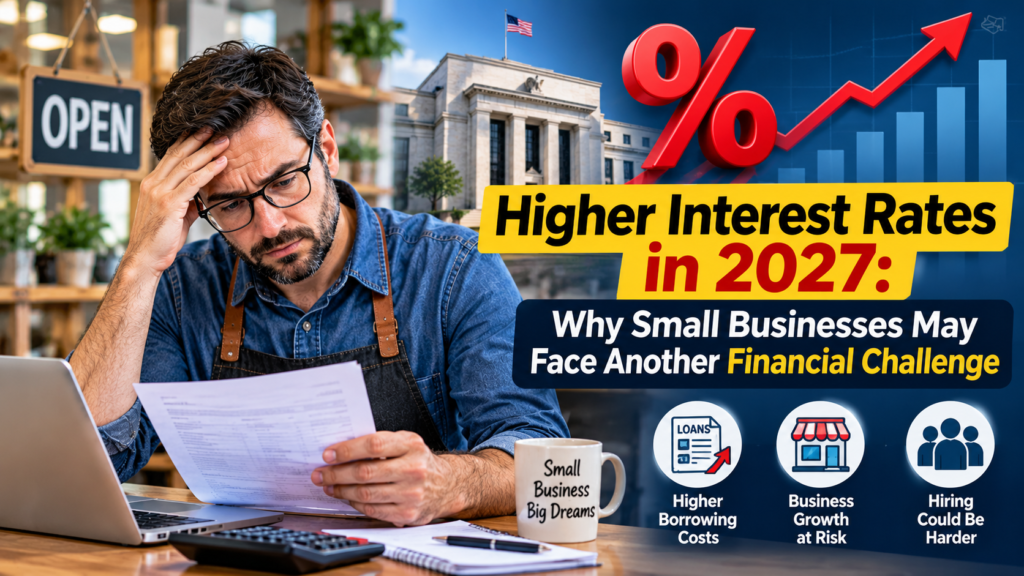
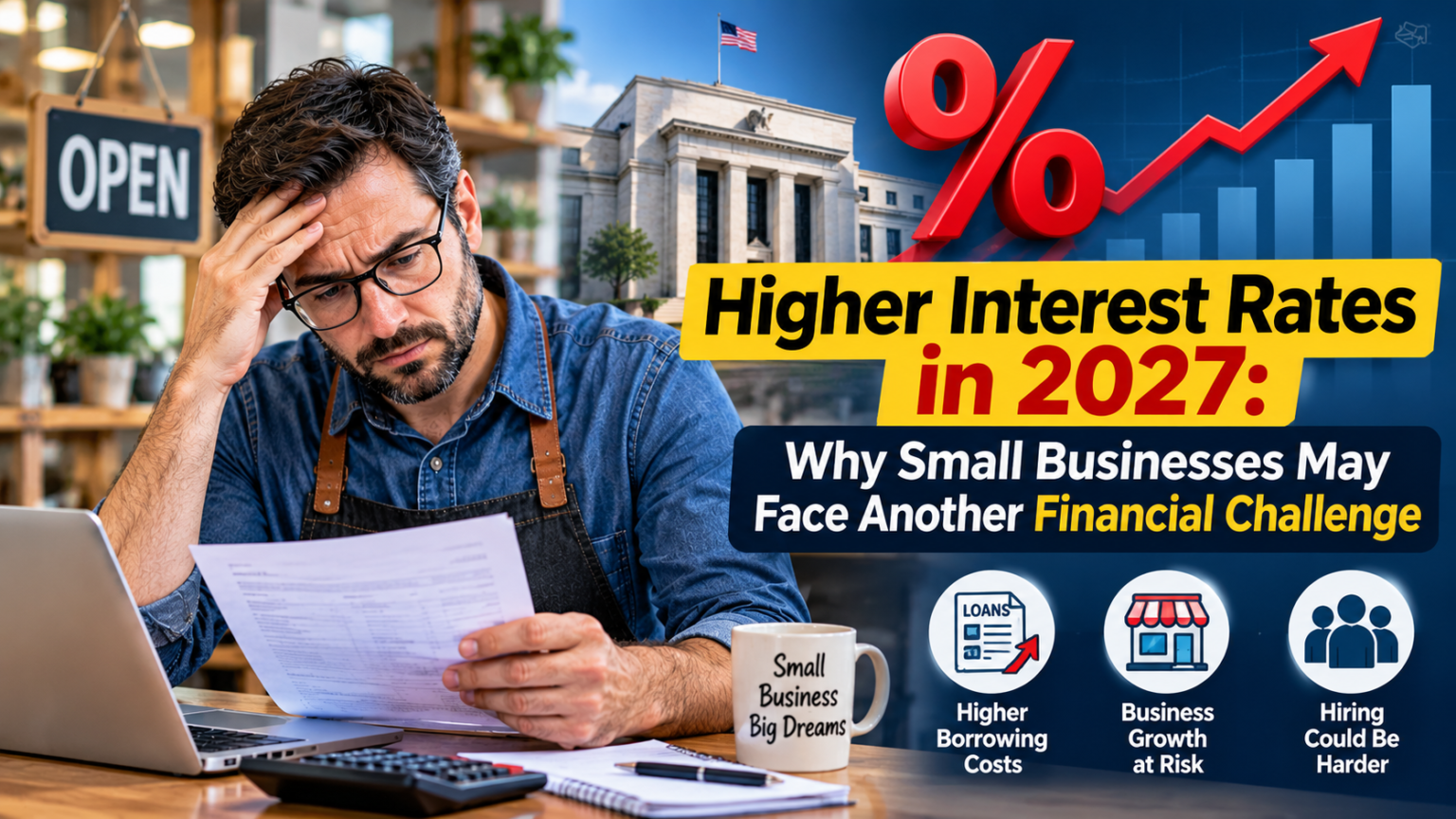

In 2027 many Small Businesses could face difficult financial situations. Even if the Federal Reserves don’t increase the interest rates immediately will affect the companies to fund expansion, manage cash flow and employee rate increase.
The Federal Reserve has kept interest rates elevated as it continues to deal with inflation. Some economists expect another rate increase, while others believe rates could remain unchanged for an extended period. At the same time, US banks have reported tighter lending standards for small businesses.
This creates a difficult situation. Even without another interest rate increase, businesses could face higher financing costs and stricter conditions when applying for loans.
Here is why small businesses may face another financial challenge in 2027 and what it could mean for their operations. Starting business now became very difficult as many fundamental laws, registrations, and funding became major issues.
1. Why interest rates will get high in 2027
The Federal Reserve uses interest rates as one of its main tools to control inflation and influence economic activity. When inflation remains above its target, the central bank may keep rates higher to reduce borrowing and spending across the economy.
At its October 27 & 28, 2026, meeting, the Federal Open Market Committee maintained its federal funds rate target range at 3.75% to 4.00%. But 2 members preferred an increase of 0.25% in the coming period. The Fed also said economic activity was expanding at a strong pace, domestic spending remained resilient and inflation was still elevated relative to its 2% goal.
These details matter for business owners because they suggest that the central bank is not ready to declare its inflation fight over. Looking ahead to 2026, the National Association for Business Economics (NABE) is also predicting that high interest rates are here to stay. Its group of experts expect there to be a further quarter point rate rise by the end of 2026. Furthermore, unlike last time, a majority of NABE members now predict there will be no rate reductions in 2027. And more members are predicting further rate rises next year.
For small businesses, the important message is that cheaper borrowing may not arrive quickly.
However, higher interest rates do not always last forever. If economic growth weakens significantly and the US enters a recession, the Federal Reserve may consider reducing rates to support economic activity. Read our guide on whether interest rates drop during a recession to understand how monetary policy can change during an economic downturn.
2. Banks are already tightening lending standards for small businesses
Higher interest rates are only one part of the problem. Getting access to loans is another.
Banks reported that they had tightened standards for commercial and industrial loans to small firms during the third quarter of 2026. Banks also reported tighter collateral requirements and greater use of interest-rate floors for small businesses. A weaker or more uncertain economic outlook, along with difficulties in specific industries, lead to stricter standards.This is important because small companies often have fewer ways to obtain financing than larger corporations. A large business may be able to issue bonds, contact several lenders, or obtain funding from investors. A smaller company may rely heavily on a local bank or a business credit line.
When banks become more cautious, business owners may face:
- More documentation and financial checks.
- Higher collateral requirements.
- Greater scrutiny of cash flow and existing debt.
- Higher interest-rate floors or loan pricing.
- More difficulty qualifying for the amount of credit they need.
It is important to understand that tighter lending standards do not mean every small business will be denied financing. However, they can make the application process more demanding, particularly for companies with limited operating history or inconsistent revenue.
3. Business loans could become more expensive
One of the most direct effects of rising interest rates is the cost of borrowing. Businesses uses loans a source of investment. When borrowing costs rises, the companies has to spend more money in repaying the debt.
One of the most direct effects of elevated interest rates is the cost of borrowing. Businesses use loans for many reasons. A manufacturer may finance new machinery, a retailer may borrow to purchase seasonal inventory, and a startup may need working capital while it builds its customer base.
Consider a simple example.
A small business takes out a $100,000 loan with a five-year repayment period. The following table shows illustrative monthly payments at different annual interest rates, assuming a standard fixed-rate loan with monthly repayments.
| Annual interest rate | Approximate monthly payment |
| 6% | $1,933 |
| 7% | $1,980 |
| 8% | $2,028 |
| 9% | $2,076 |
This looks meaningless at first, but higher payments can affect the availability of money spending on Factor of Production covering the costs. For small businesses with small profit margins, even a small increase in monthly debt payments can affect its financial flexibility. It is also worth remembering that business loan rates do not automatically move by the same amount as the federal funds rate. Lenders consider their own funding costs, the borrower’s credit risk, collateral, loan duration and other factors.
4. Startups and new businesses could face greater pressure
The start-ups may face financial problems making it a hard time obtaining financial support. A startup may have a strong business plan, but the lenders still need a proper guarantee that the company will repay its debt on the due date. Higher borrowing costs could make this situation more difficult in 2027.
For example, a new technology company may need funding to develop its product, hire developers and attract its first customers. A restaurant may need money for equipment, rent and initial inventory. A small manufacturer may need financing before it can begin producing goods at scale. If loan payments become more expensive, founders may have to reconsider how quickly they expand.
However, alternative financing is not automatically cheaper or safer. Business owners should compare the full cost, repayment conditions and risks before choosing a funding option.
5. Higher rates could affect hiring and business expansion
Borrowing costs don’t only affect loans, but it also influences business decisions. When a company spends more money on interest payments, it has less flexibility for growing and to invest. A business owner may delay his plans of expanding the business.
This is particularly important for small businesses because expansion often requires upfront payments.
Higher borrowing costs can make mortgages, credit cards and other loans more expensive for households. If consumers reduce discretionary spending, some small businesses may experience weaker sales.
Restaurants, independent retailers, home improvement companies and other consumer-facing businesses could feel this pressure if customers become more cautious with their spending.
The overall impact will depend on the strength of the economy, household incomes, business demand and how long interest rates remain elevated.
7. Which small businesses could feel the pressure most?
Not every business is affected in the same way. Companies that rely heavily on borrowed money may be more exposed than those with strong cash reserves and limited debt.
| Business type | Possible financial pressure |
| Startups | More difficult access to early-stage financing |
| Retail businesses | Higher inventory financing costs and potentially weaker customer spending |
| Restaurants | More expensive equipment loans and working-capital credit |
| Manufacturers | Higher costs for machinery, materials and expansion |
| Construction companies | More expensive project financing and equipment purchases |
| Small technology firms | Higher costs of funding product development and hiring |
These are potential areas of exposure, not a prediction that every business in these industries will struggle.
A company’s financial position, customer base, debt structure and ability to adjust prices will all influence how strongly it is affected.
8. What can small businesses do to prepare for 2027?
Business owners cannot control Federal Reserve policy, but they can review their finances and prepare for different borrowing conditions. Here are several practical steps worth considering.
- Review existing loans
Those running a business should ascertain if their loan is fixed or variable. Loans can either be set at a specific interest rate for the duration of the loan, or they can be variable, meaning that the interest rate may fluctuate depending on the loan agreement. This information can therefore enable a business to recognise when and where interest rates may increase in the future.
- Improve cash-flow management
When businesses need additional cash they may need to improve and review income and expenses which can help them to identify periods when they require more investments. Companies also examine unpaid invoices, supplier payment schedules and unnecessary operations costs.
- Compare financing options
Before borrowing money for investments, the startups should compare the interest rates, their cost, and repayments period and other conditions including the collateral requirements in case they fail to repay. Just by comparing these conditions with previous years can reveal the full cost estimation or risk of Loan.
- Avoid unnecessary borrowing
If an expansion project can be delayed without harming the business, owners may want to examine whether borrowing immediately is necessary. The decision should depend on expected returns, cash flow and the total cost of financing.
- Maintain financial records
Banks may examine revenue, expenses, existing debt and repayment capacity when assessing loan applications. Keeping accurate financial statements and tax records can help business owners present a clearer picture of their company’s position.
- Build a financial cushion
Where possible, maintaining cash reserves can reduce the need to rely on expensive short-term borrowing when unexpected expenses arise.
Business owners should also prepare their financial documents before applying for additional funding. The US Small Business Administration’s guide to preparing for business funding explains how companies can present financial statements, review business credit reports and prepare revenue and expense forecasts. Having these records ready can help lenders understand the company’s financial position and assess its ability to repay a loan.
Conclusion: Small businesses may need to prepare for expensive borrowing
With the possibility of increase in interest rate in 2027, creates another concer for small business may face in relation to controlling expenditure and cost.
In October, the Federal Reserve maintained the key interest rate at 3.75-4.00%. Furthermore, the November NABE survey of economists indicated that they anticipate rates will stay high into 2027. The Fed’s bank lending survey also highlighted that banks have raised their lending criteria for small businesses.
This indicates that obtaining suitable finance could continue to present an issue. Whilst the likelihood of further interest rate rises exists, there is scope for inflation to fall. In addition, the economic climate may alter and the Federal Reserve may conclude that it is suitable to reduce interest rates.
At present, it is therefore advisable for small businesses to monitor and assess their financial commitments, cash flow and financial requirements. Anticipating increased borrowing costs may enable firms to more thoroughly evaluate their options for growth, recruitment and investment in 2027.