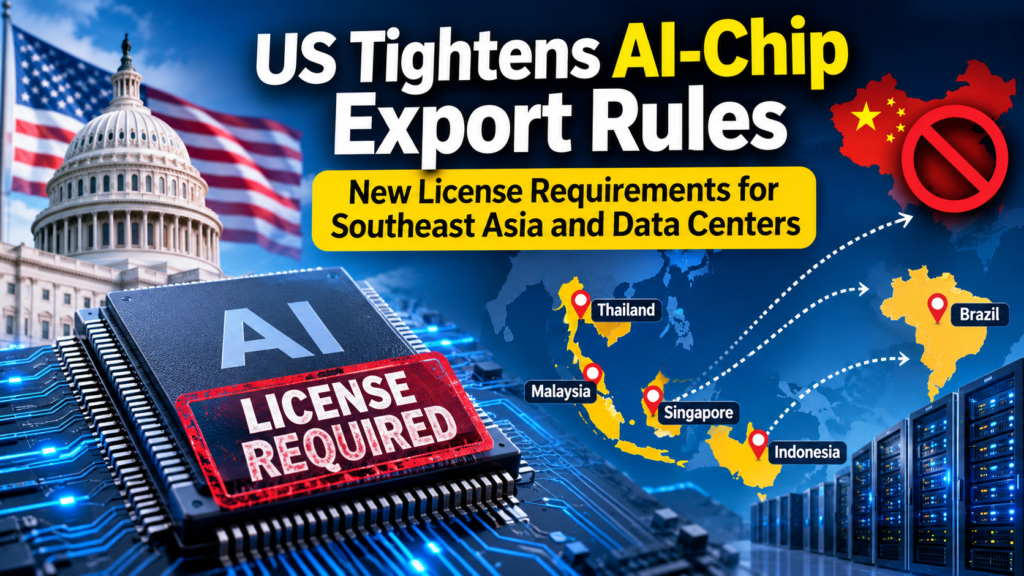
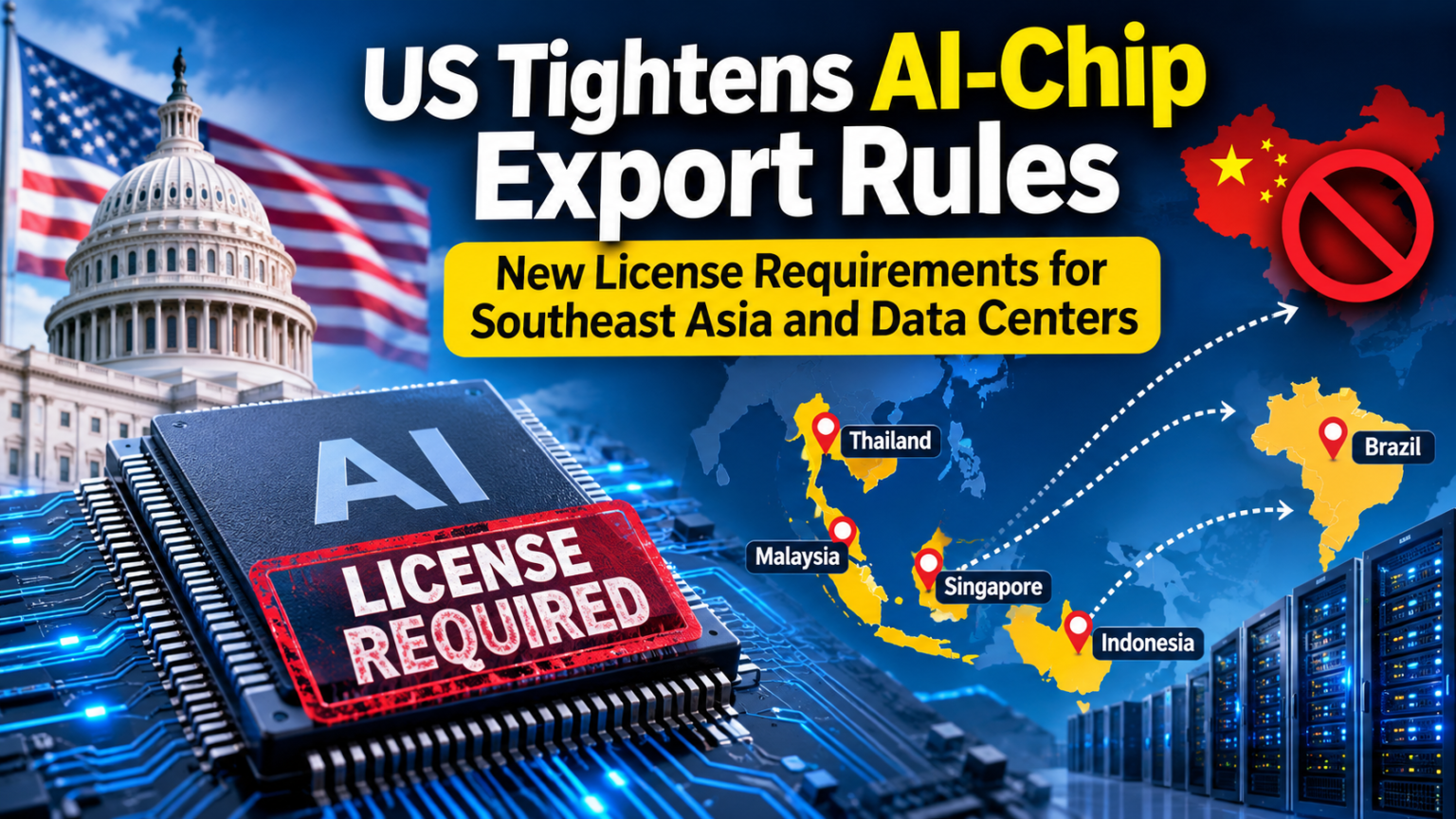

The United States has introduced new export controls aimed at preventing advanced AI chips from reaching Chinese companies through third countries and overseas data centers. The US Commerce Department has added a new rule for AI chips exports which will require licensing for covered advanced semiconductor shipments to Indonesia, Malaysia, Singapore, Thailand, and Brazil, which Washington identifies as carrying a higher-than-normal risk of diversion to China.
The US Commerce Department’s Bureau of Industry and Security issued the interim final rule as part of a broader effort to restrict remote access to advanced AI computing power. The rule uses Super Intelligence in place of artificial intelligence, under Executive Order 14434, and is titled “Addressing Remote Access to Advanced Semiconductors”. Rather than focusing only on direct shipments to China, the measure targets intermediaries and data-center routes that could allow Chinese-headquartered firms to use US-origin chips located abroad.
What the rule requires
The new export framework broadly requires companies to secure a US license to export, re-export, or transfer covered advanced chips to or within the five designated countries. Washington says the measure is designed to close a critical loophole and prevent chips shipped through Southeast Asia or Brazil from ultimately fueling Chinese AI development.
The rule also creates a worldwide end-use control for data centers. A license is required when a supplier knows, or has reason to know, that advanced chips or servers are destined for a data center that will provide more than 12 million aggregate TPP of computing power to companies headquartered in China or another covered jurisdiction.
90-day deadline
Data centers that were already providing significant computing capacity to covered companies before the rule’s publication must obtain a US export license within 90 days if they want to continue those services. Companies that do not comply could face future export restrictions.
The requirement is designed to prevent Chinese firms from effectively accessing restricted US compute by leasing capacity from data centers outside China. It shifts compliance responsibility toward chip suppliers, cloud providers, and data-center operators that must assess who ultimately benefits from their computing services.
New rules for overseas data centers
The interim final rule adds a new end-use restriction under EAR Section 744.24. Advanced semiconductor items may not be exported, re-exported, or transferred within the United States without a license if they are known by the exporter to be used in a data centre located in any country that provides over 12 million cumulative Total Processing Performance (TPP) to entities based in Macau, or a Country Group D:5 destination (which includes China).
The restriction applies whether access is direct or indirect. It also covers situations where a data center provides remote access to a customer outside a restricted jurisdiction, but that customer is training models for, assisting in training models for, or supplying models to a covered company
The 12 million limit may be achieved using one or multiple data centres. If data centres can be used as one resource pool, to balance load, and to mirror data by being connected together with network infrastructure, they will be considered to be connected. This applies regardless of whether the data centres are physically or virtually connected.
Changes after shipment
The rule also addresses changes in how advanced chips are used after they have been exported. If a data center begins supplying significant computing capacity to a covered company after the chips are shipped, its owner, operator, or another transferor must obtain a license.
A shift from a permitted end use to a prohibited one is treated as an in-country transfer under the rule. The restriction can also apply to a party in possession of the advanced items even if that party was not involved in the original export transaction.
Exemptions and impact
The licensing requirement for the five named countries does not apply when advanced chips are destined for companies headquartered in the United States, subject to applicable reporting conditions. This carve-out is intended to preserve access for US-headquartered firms while tightening scrutiny of shipments that could be diverted elsewhere.
For Southeast Asia, the rule could affect the region’s rapidly expanding data-center sector, particularly operators serving Chinese-headquartered customers or relying on large-scale AI infrastructure. Analysts expect greater compliance costs, more detailed customer screening, and possible delays in chip procurement for affected facilities.
Why it matters
US export controls are starting to target the wider ecosystem enabling AI computation. By imposing restrictions on trans-shipment hubs and remote data centres, the U.S. hopes to make it more difficult for restricted Chinese entities to gain access to high performance computing capabilities.
Within AI, cloud, semiconductors and data centre industries, companies should consider their supply chains, locations of customers, levels of computing capacity and licensing requirements. This continues the trend of viewing access to high performance computing resources for AI as a national security risk.