


Why This Guide Matters Now
The global market is experiencing an increase an increase in the amount of digital transformation being adopted from $2.1 trillion in 2025 to $2.54 trillion in 2026, which represents a compound annual growth rate of 20.8%. By 2030, This will hit $5.01 trillion. Spending is not the issue.
At the end the problems are concluded in results. Digital transformation’s failure rate holds at 70% in 2026, with an estimated $2.3 trillion wasted yearly in initiatives that never deliver their promised results. Bain found that 88% of transformations never reached their original ambitions.
Here’s the critical insight: 70% of those failures come down to employee resistance and poor adoption not technology. The software worked. The transformation didn’t.
This digital transformation guide is intended for entrepreneurs and small business owners who want to avoid becoming a part of that statistic. It covers the necessary digital transformation definition for different levels of understanding, including such terms as digital process, digital process automation, and digital transformation management.
What Is Digital Change and Why It’s Different from Digital Transformation
Digital change refers to progressive changes which is adopting the digital tools and processes across Business, showing results of continuous digital transformation. It’s not a short term project. It’s the continuous step-by-step evolution of how the work is done with more accuracy.
Digital transformation, on the other hand, is a strategic, organization-wide overhaul. It typically involves rethinking business models, rebuilding supply chains, and integrating AI across core operations.
Why do the small businesses care for this?
Because most of the SMBs need a huge investment for transformation. They need ongoing digital change. A local retailer may need to switch from paper inventory management to a cloud-based system a digital improvement. Rebuilding the entire supply chain around predictive AI is transformation.
The data proves this point. Small businesses adoption of AI grew by 55% year-over-year. But only 14% of them have incorporated it into their core operations. The issue is not with the adoption rate but with the transformation one small step at a time. The gap isn’t between implementing or not but it’s between adapting the tools with more precision and actually embedding them into how the business should be managed.
For entrepreneurs, the lesson is clear: begin with digital change. Choose one process. Digitize it. Measure the outcome. Then proceed to the next one. Transformation comes about through accumulation, not through one big-bang project.
What Is Digital Process? An Essay Explanation:
A digital process in any business workflow that uses the digital tools, data and automation instead of using manually intensive and paper-based procedures. This is the most basic definition since the term digital processes encompasses a lot more than just these examples. Generally,
There are three key types of digital processes, which are described below.
Operational processes: It’s the core business processes needed to produce products or services. An example of such a process is order fulfillment, which is performed by applying digital tools. They feature automation and do not require human interference.
Management processes are used to determine, lead, and control organizational processes. An example of such a digital process is a dashboard that displays key performance indicators in real-time instead of reviewing spreadsheets.
Supporting processes: The third category is the supporting processes, which are required to maintain operations. One of the typical examples is the automated onboarding of new employees, which involves contract signing, training, and access granting procedures.
Here’s a quick comparison:
| Manual Process | Digital Process |
| Paper invoice approval chain | Automated approval routing via email or app |
| Verbal customer intake | Digital form with auto-populated CRM entry |
| Spreadsheet-based inventory | Cloud inventory with real-time alerts |
Understanding what digital process means is the first step in any digital transformation guide. You can’t automate what you haven’t mapped.
Digital Process Automation: The Engine of Modern Business Efficiency
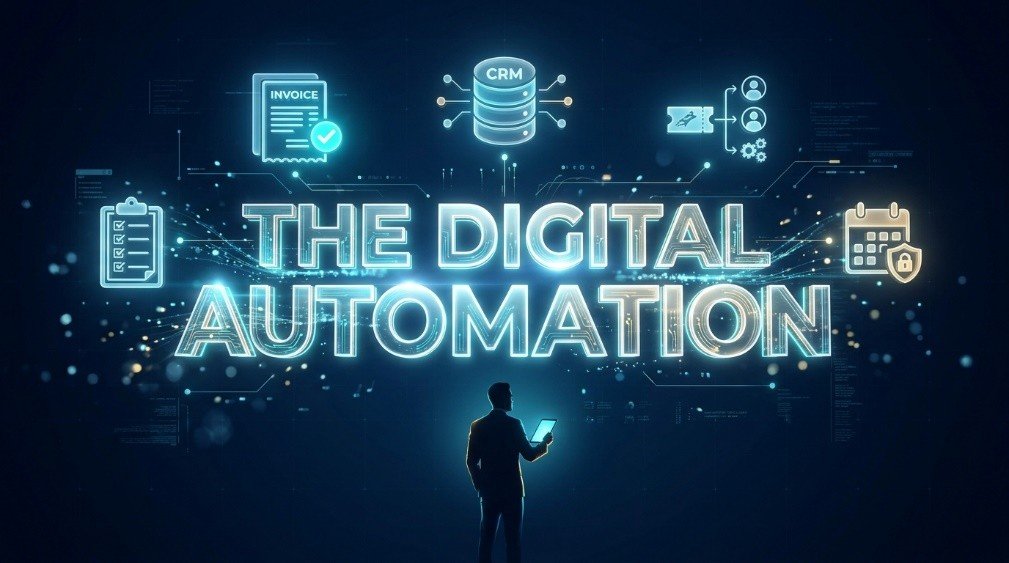
Digital process automation (DPA) uses the software to accomplish various repetitive operations or tasks, whether approval, data entry, document routing with minimal or zero human intervention. It is the execution layer that realizes the processes defined by DPA tools.
Unlike general-purpose software for automating individual tasks, DPA has a broader scope. It involves using automation tools, integrated systems, and low-code development platforms to create end-to-end automated processes that span multiple departments and steps.
The tools for automation are proliferating and becoming easy to use. For instance, Intuit has introduced artificial intelligence (AI) tools that allow users to describe in plain language what they want to achieve and then proceed to execute the desired outcome. With the new tool, customers can create invoices and reminders, and send them automatically to customers using their phones or email. NetSuite has announced the launch of a new artificial intelligence financial application for small businesses to automate financial management, accounting, and cash flows. Wix has announced Symphony, a multi-agent system designed for small and medium-sized enterprises that enables businesses to harness the power of AI agents to execute processes tailored to their needs.
Five automated procedures can be implemented within a short time.
- Automated invoice approval and payment reminders reduces the manual follow-ups and late payments
- Employee onboarding workflows can be automated hence saving time, effort, generation and training assignments.
- Customer support ticket routing can be routed and processed automatically according to their nature and severity.
- Lead capture and CRM auto-entry through websites can be added to a customer relationship management (CRM) system automatically.
- Compliance document tracking, documents can be tracked automatically to remind individuals when they are due or overdue.
Digital Transformation Management: How to Lead Change Without Chaos
Digital transformation management is the governance process of planning, implementing, and monitoring digital change. It is important in the system of governance to ensure that automation does not run rampant.
In the studies conducted, critical success factors in digital transformation were identified. Leaders and strategic alignment were found to be consistently critical success factors. Other factors include process, technology, and user-friendly design as well as continuous improvement.
For small and medium enterprises, a two-domain (vertical and horizontal) reference model was introduced by IEEE. It is intended for smaller companies with scattered activities and insignificant resources for transformations. The vertical component is IDEAL – an approach that addresses internal processes through continuous improvement. The horizontal component is ACT, a method focused on external factors in transforming an enterprise.
According to the new framework, process maturity determines technological sophistication. Therefore, the introduction of cyber-physical systems and big data analytics is considered a continuous improvement initiative and should be taken step by step.
Transformations can fail due to various reasons. The main cause of failures in about 70% of cases is linked to changes in employees’ behavior. Changes in such a large group of people are always risky, and there are many examples of transformation failures due to inadequate consideration of this aspect. About 45% of respondents believe that tools are often introduced without adequate training, and about 63% of employees stop using untrained tools.
Here’s a digital transformation management checklist for SMBs:
- Identify 3 manual processes that cost the most time each week
- Assign a transformation owner someone with decision-making authority
- Map the current workflow before automating anything
- Choose one pilot project with measurable goals (e.g., reduce invoice processing from 4 hours to 1)
- Train staff before launch, not after
- Review results at 30, 60, and 90 days
- Scale what works; kill what doesn’t
For homeowners and entrepreneurs: the most critical success factor on this list is training. If you are automating any process for your staff, budget for training with the same seriousness as you would for buying the software itself. The Firefly Photography example demonstrates this principle perfectly. The key to their success was engaging their staff and managing their expectations.
Conclusion: Digital Change Is a Marathon, Not a Sprint
This guide to digital transformation was started with a simple insight: digital change is interactive while digital transformation is strategic. Most often, businesses and particularly small organizations succeed with the former before even thinking about the latter.
The below guide highlights actionable tips to begin with:
- What is digital process? Any workflows utilizing some form of digital tools over manual steps count, and it is critical to map these out before automating them
- Digital process automation is about execution: pick a process that lends itself well to automation (invoicing, onboarding) and begin standardizing it, as well as monitoring adoption
- At the level of Digital transformation management, the focus shifts to the users: software adoption training is critical, and so is user adoption analytics
The companies that will see the best results for their digital transformation efforts in 2026 will not be the ones that have invested more. They will be the ones that have invested wisely: in user behaviors, in other words. And in order to begin with such transformations, companies should invest time this week in defining a process, mapping it, and automating it.