
The internet you use every day, whether that is scrolling through Instagram, sending money through PayPal, or watching a video on YouTube, all of it runs on a system where someone else is quietly in charge. A company owns the platform. A corporation stores your data. An algorithm decides what you see. Most people never stop to think about this because it has always been the way things work. But a growing movement in technology is trying to change that arrangement from the ground up, and it goes by the name Web3.
You have probably heard the word thrown around in tech news, crypto conversations, or maybe a YouTube video that left you more confused than before. That is fair. Web3 carries a lot of hype, and the people who talk about it most enthusiastically are not always the best at explaining it simply. This article is going to do exactly that. By the end, you will have a clear picture of what Web3 actually is, what problems it is trying to fix, and how it might change the way ordinary people experience the internet.
The Internet Did Not Always Work the Way It Does Now
To understand Web3, you need to know a little bit of history. The internet has gone through two distinct phases before arriving at this moment, and each one changed what people could actually do online.
The first version of the internet, which people call Web1, ran from roughly the early 1990s to the early 2000s. It was essentially a massive collection of read-only pages. You could visit a website and read what was on it, but you could not post anything, leave a comment, or interact with other people. Think of it like a digital encyclopedia. A librarian puts books on the shelf and you read them. That was it.
Then came Web2, which is the internet most people alive today grew up with. Web2 changed the game by making the internet interactive. Suddenly, anyone could create content. Facebook, YouTube, Twitter, Reddit, Wikipedia, all of these platforms became the internet for billions of people. Users were no longer just reading. They were posting, commenting, sharing, building communities, and spending hours every day on apps that felt like they were made just for them.
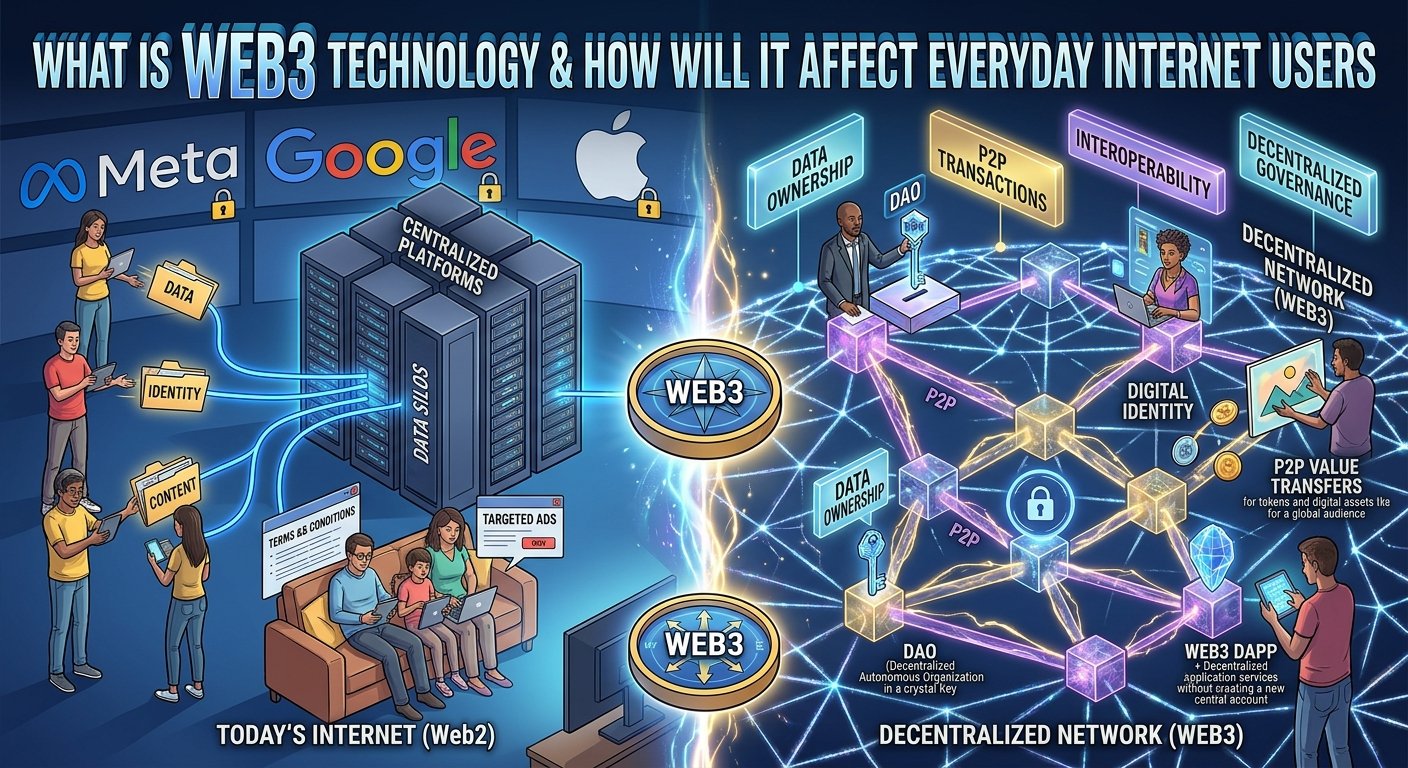
Here is the problem with Web2, and it is a big one. The companies that built those platforms own everything that happens on them. When you sign up for a social media account, you hand over your personal information, your browsing habits, your likes and dislikes, your location history, and in return you get to use the platform for free. You are not the customer. You are the product. The company sells your data to advertisers, and you see personalized ads around the clock. If the company decides to ban your account, close the platform, or change its rules overnight, there is nothing you can do about it. Your account, your content, your connections can vanish because someone in a corporate office made a decision.
Web3 is an attempt to build a new internet that does not work that way.
So What Exactly Is Web3
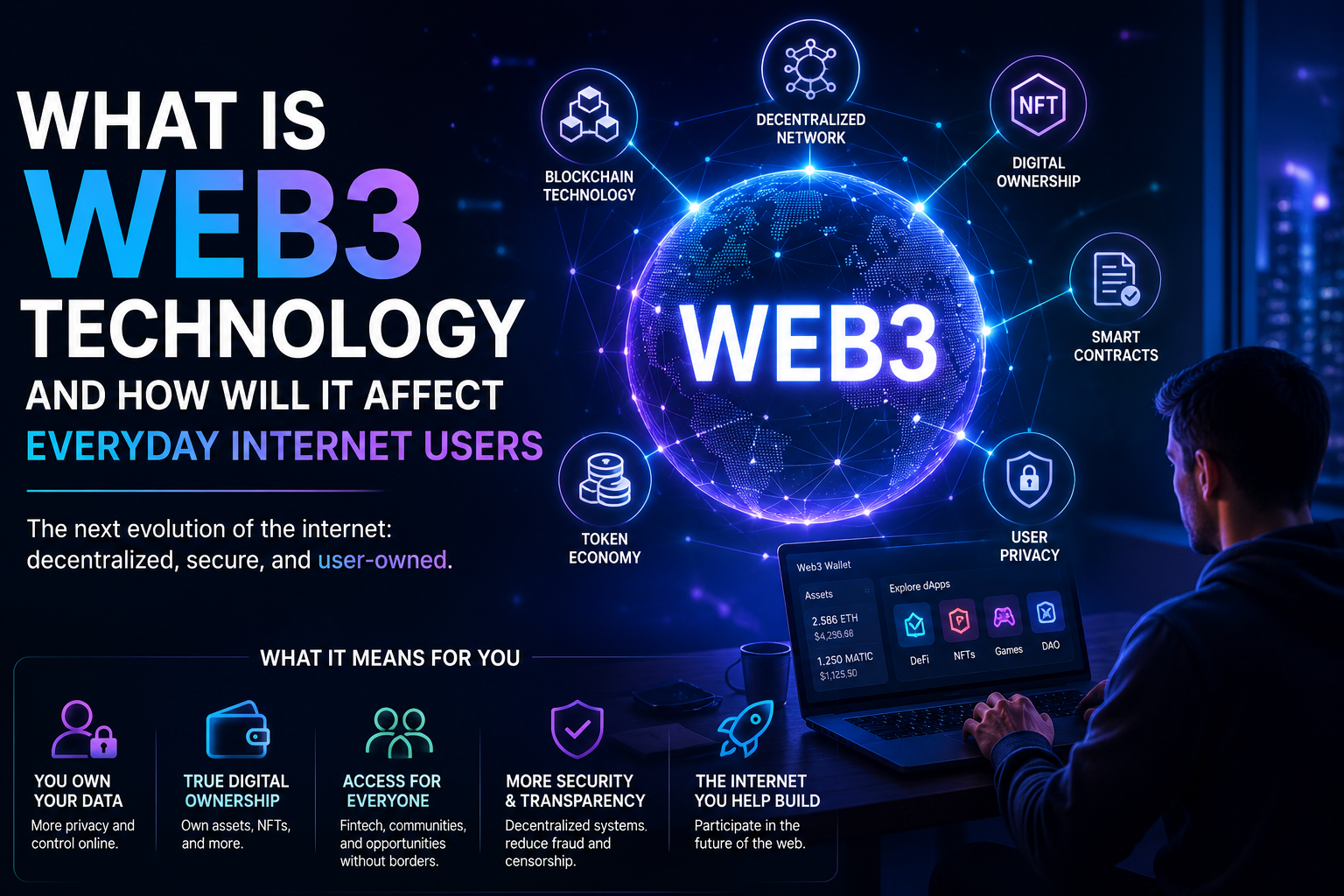
Web3 is a term used to describe the next version of the internet, one that is built on blockchain technology and is designed to give users direct ownership and control over their data, their digital assets, and even their online identities. The core idea is decentralization. Instead of your data living on a server owned by Google or Meta, it lives across a distributed network of computers spread around the world. No single company, government, or authority controls that network.
The term itself was coined by computer scientist Gavin Wood, one of the co-founders of Ethereum, back in 2014. His vision was an internet where trust does not depend on trusting any single party. You do not need to trust Facebook to protect your data because your data does not live on Facebook’s servers in the first place. The system itself enforces the rules through code.
Three technologies power most of what Web3 promises.
The first is blockchain. A blockchain is a digital ledger, essentially a giant shared record book, that stores data in a chain of blocks. Every block contains a set of verified transactions, and once something is written into the chain, it cannot be altered or deleted. This makes the data tamper-proof and transparent. Anyone can verify what happened, but no one person controls the ledger.
The second is smart contracts. These are pieces of code written directly onto a blockchain that automatically execute when certain conditions are met. Think of a vending machine. You put in the right amount of money, press the button for your snack, and the machine gives it to you. No cashier, no manager, no middleman. A smart contract works the same way. If you and someone else agree on a set of conditions, the contract enforces them automatically without either of you needing to trust the other party, and without a lawyer or a bank getting involved.
The third is tokens and digital wallets. In Web3, users carry a digital wallet that acts as both their identity and their bank. This wallet is theirs completely. It is not tied to a platform or a company. They can use it across different applications, hold digital currencies, and prove ownership of digital assets.
The Real Ways Web3 Will Change What You Do Online
This is where things get interesting, because Web3 is not just a technical upgrade. It has the potential to change the relationship between ordinary internet users and the platforms they spend their time on.
You could actually own your data. Right now, every photo you post on Instagram belongs to Instagram in the sense that Instagram controls it, benefits from it, and can remove it at any time. In a Web3 world, your content lives on a decentralized network and is tied to your personal wallet. If Instagram went bankrupt tomorrow, your content and your audience would not disappear with it. You take them with you to the next platform.
Banking and finance could become open to everyone. One of the most significant applications of Web3 technology is Decentralized Finance, which people shorten to DeFi. DeFi platforms use smart contracts to offer financial services like lending, borrowing, earning interest, and trading without a traditional bank acting as the middleman. This matters enormously for the roughly 1.4 billion people around the world who do not have access to a bank account but do have access to a smartphone. A farmer in a rural area of Pakistan or Kenya could potentially borrow against their digital assets or earn a yield on their savings through a phone app, no credit score or branch visit required.
Social media could pay you instead of using you. Decentralized social platforms are being built right now that reward users for creating content and engaging with others. On these platforms, creators receive tokens directly rather than a tiny fraction of ad revenue filtered through a corporation. Platforms like Lens Protocol are experimenting with models where your social profile is an asset you own as an NFT, meaning it travels with you across the internet rather than belonging to one app.
Digital ownership of games and art becomes real. If you have ever spent money on an in-game skin or a virtual item in a video game, you know that you do not actually own that item. If the game shuts down, your purchase disappears. NFTs, which stand for Non-Fungible Tokens, are a Web3 technology that creates verifiable proof of ownership for digital items. A game built on Web3 principles could let you truly own the sword you earned or bought, sell it to another player, or take it into a completely different game. The same concept applies to digital art, music, and other creative work.
Your online identity becomes yours to control. Right now, most of us log into websites using our Google or Facebook accounts because it is convenient. That convenience comes at a cost: those companies know every site you visit. In Web3, your digital wallet becomes your universal login. You prove who you are without handing a corporation a map of your entire internet life.
The Challenges That Cannot Be Ignored
It would not be honest to talk about Web3 without talking about the very real problems it still has.
First, it is complicated. The average person who wants to use a Web3 application today has to set up a digital wallet, write down a recovery phrase of twelve random words and guard it with their life, understand gas fees, and navigate interfaces that were clearly designed by developers for other developers. If you lose your private key, the password that proves ownership of your wallet, you can lose everything in it permanently. There is no customer service line to call and no password reset button.
Second, the space has attracted a remarkable number of scams. Because Web3 is still largely unregulated and transactions are irreversible, bad actors have found it easy to run schemes that drain users of their funds. Fraudulent NFT projects, fake DeFi platforms, and phishing attacks on wallets have cost regular people billions of dollars over the past few years. Anyone entering this space needs to approach it with serious caution and thorough research.
Third, the promise of true decentralization is still partly theoretical. Many projects that call themselves Web3 rely heavily on centralized infrastructure in practice. The code might live on a blockchain, but the interface you use to access it often still lives on traditional servers. A handful of large players have also gained enormous influence over blockchain networks in ways that mirror the centralization problems Web3 was supposed to solve.
Fourth, blockchain transactions consume significant amounts of energy, though this concern has lessened considerably since Ethereum, the largest smart contract platform, switched to a much more energy-efficient system in 2022.
Where Things Stand Right Now
Web3 is real, but it is still early. As of 2025, somewhere around 420 million people globally interact with Web3 applications in some form, but the vast majority of those users are concentrated in a small number of countries and are still primarily motivated by financial speculation rather than the broader vision of a decentralized internet.
The technology is maturing rapidly though. Large institutions like JPMorgan are processing billions of dollars in transactions on private blockchain networks. Estonia has been running a blockchain-secured digital identity system for its citizens for over a decade. Companies like Microsoft have launched decentralized identity networks designed to let people carry tamper-proof credentials, like university diplomas, without relying on a central authority.
The user experience is also improving. Newer Web3 applications have started allowing users to log in with Apple Pay or Google accounts as an entry point, hiding the complex machinery underneath so that ordinary people do not need to understand blockchain to benefit from it.
The path from here to a fully realized Web3 internet is not guaranteed, and no one can say exactly how or when it will arrive for the average person. But the direction of travel is clear. The internet is slowly shifting toward a model where users have more ownership, more privacy, and less dependence on a handful of technology giants who currently decide the rules for billions of people.
What This Means for You Right Now
You do not need to become a blockchain developer or invest in cryptocurrency to start understanding Web3. The most useful thing you can do today is pay attention to what is changing, think critically about the platforms you use and what they take from you in exchange for their services, and stay curious about alternatives as they become more accessible.
The internet changed everything once. It changed how we communicate, how we learn, how we shop, how we work, and how we build relationships. The people who understood where it was going early had advantages that compounded over years. Web3 may not replace the internet you know overnight, but the shift has already started. The question is whether you will understand what is happening when it reaches you.
For a deeper look at how blockchain technology works as the foundation of Web3, the explanation at Ethereum.org is one of the clearest available. For a well-researched overview of Web3’s possibilities and current limitations from a business perspective, McKinsey’s Web3 explainer at mckinsey.com is worth the read.