
There is a quiet revolution happening in finance. It does not involve Wall Street bankers or government central banks. It does not require you to wait three business days for a wire transfer to clear. It does not ask for your credit score, your government ID, or even your name. It runs twenty four hours a day, seven days a week, and anyone with an internet connection can access it from anywhere on the planet.
That revolution is called DeFi, short for decentralized finance, and over the past few years it has gone from a niche experiment to one of the most talked about topics in the entire financial world. By October 2025, more than 150 billion dollars worth of assets had been deposited into DeFi platforms by people all over the world. That is not a typo.
But what actually is DeFi? How does it work? And should a complete beginner even care about it?
This guide is going to answer all of those questions. We are going to start from the very beginning, build up your understanding step by step, and by the time you finish reading, DeFi will make complete sense to you.
The Problem That DeFi Is Trying to Solve
To understand DeFi, you first need to understand what is broken about the current financial system, because DeFi did not appear out of nowhere. It was built as a direct response to real problems that billions of people face every single day.
Think about what happens when you want to send money to a family member in another country. You walk into a bank or open your banking app, you initiate the transfer, you pay a fee that could easily run between twenty five and fifty dollars, and then you wait. Sometimes you wait days. The bank processes it on its schedule, during its hours, and if something goes wrong, you call a customer service line and hope someone can help you.
Now think about the 1.7 billion adults on this planet who do not have a bank account at all. No credit history. No branch nearby. No access to any of this. For these people, getting a loan, earning interest on savings, or even sending money to someone else is a massive challenge.
Traditional finance was built on the idea that you need a trusted middleman sitting in the middle of every transaction. That middleman, whether it is a bank, a broker, or a payment processor, keeps the records, approves or denies transactions, sets the fees, and ultimately controls access to financial services. The system works reasonably well for people who fit the right profile, but it leaves out a huge portion of the global population and charges significant fees for the privilege of participation.
DeFi was designed to change all of that.
So What Exactly Is DeFi?
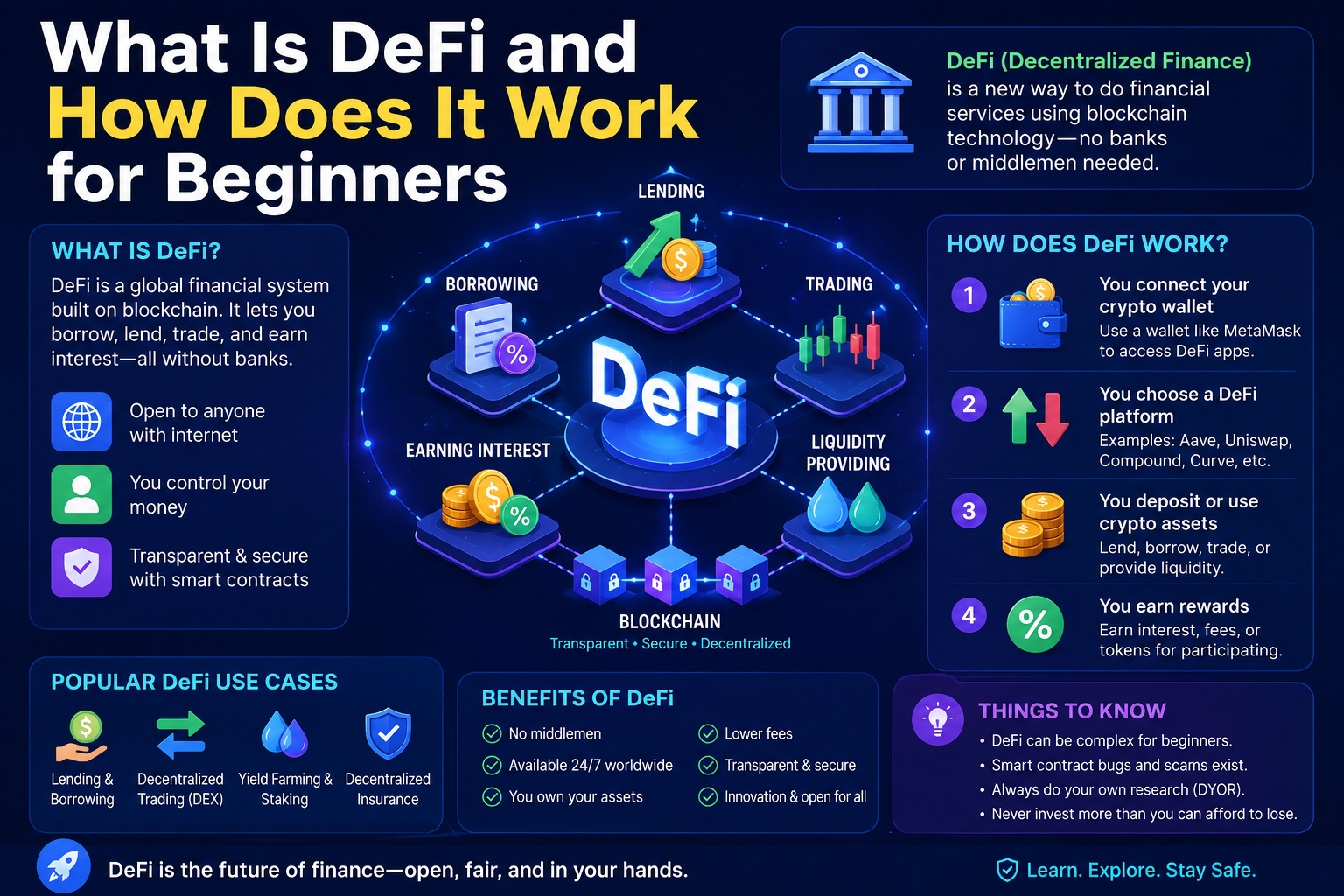
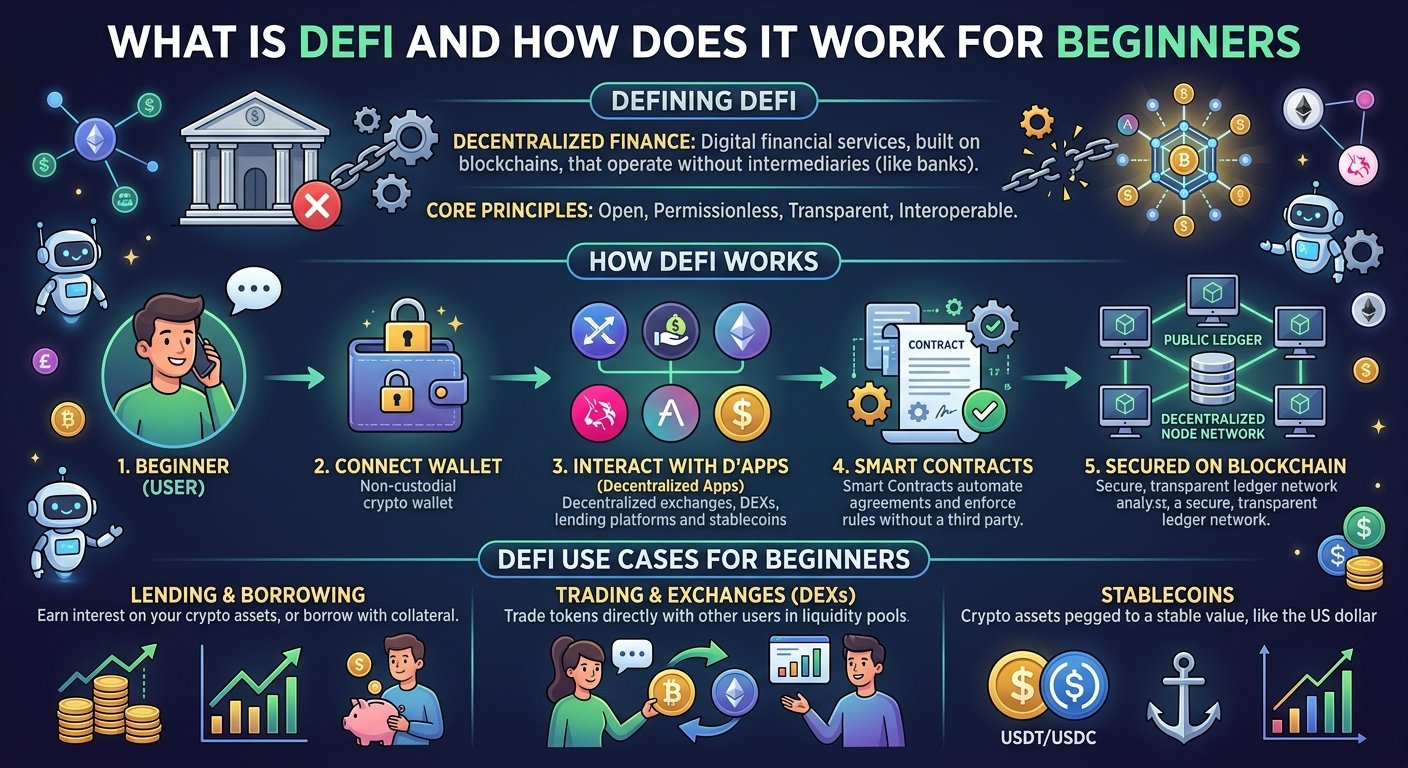
Decentralized finance is a system of financial services that operates on blockchain networks instead of through traditional financial institutions. It allows people to lend, borrow, trade, save, and earn interest without using a bank, broker, or any other centralized institution as the middleman.
Instead of trust being placed in a company or a person, DeFi places trust in code. Specifically, in something called smart contracts, which we will cover in detail shortly. The idea is that if the rules of a financial agreement are written into transparent, publicly verifiable code that executes automatically, then you do not need to trust the other party or a third party institution. You just need to trust the math.
DeFi is mainly built on the Ethereum blockchain, though other networks like Solana, Avalanche, and Polygon have developed their own DeFi ecosystems. Anyone with a crypto wallet and an internet connection can access these platforms. There is no application process, no credit check, and no business hours. The system is open to anyone, and it runs continuously without interruption.
To put it simply: DeFi is like having access to a full-featured bank, except no bank actually exists. The services are automated, the rules are transparent, and nobody can freeze your account or deny your application.
The Technology Behind DeFi: How It Actually Works
Understanding how DeFi functions requires getting familiar with three core building blocks: blockchains, wallets, and smart contracts. Once you understand these three things, everything else in DeFi clicks into place.
Blockchain: The Foundation
A blockchain is a type of database that stores information differently from a normal database. Instead of keeping records on a single server controlled by one company, a blockchain copies and stores the same records across thousands of computers around the world simultaneously.
Every transaction that happens on a blockchain is recorded in a block, and those blocks are chained together in order. Once a transaction is recorded, it cannot be altered or deleted. The record is permanent and visible to anyone who wants to look at it. This is what people mean when they say blockchain is transparent and immutable.
When DeFi applications use a blockchain as their foundation, it means that every single transaction happening on those applications is recorded publicly, permanently, and without the possibility of a single company manipulating the records.
Your Crypto Wallet: The Gateway
In DeFi, you do not create an account with a username and password. Instead, you use a crypto wallet. A wallet is a piece of software (or hardware) that holds your private keys, which are essentially the proof that you own your funds on the blockchain.
The most widely used wallet for DeFi is MetaMask. It works as a browser extension or a mobile app, and it lets you store, send, and receive cryptocurrency while also connecting you to DeFi applications with a single click. Over 30 million people around the world use MetaMask to access the decentralized web.
Your wallet has a public address, which is like your bank account number. Anyone can send funds to that address. But only the person with the private key, essentially a secret password, can move those funds. This means that in DeFi, you are always in full control of your own assets. Nobody can freeze your account. Nobody can decide your transaction is not approved. The funds are yours.
The critical rule that every DeFi user learns quickly: never share your private key or your seed phrase (the twelve or twenty four words that back up your wallet) with anyone under any circumstances. Anyone who has these can take everything in your wallet.
Smart Contracts: The Engine That Makes It All Run
Smart contracts are probably the single most important concept in DeFi, and they are not as complicated as the name makes them sound.
A smart contract is simply a program written in code and deployed on a blockchain. The contract contains a set of rules, and whenever the conditions of those rules are met, the contract executes automatically without any human involvement.
Here is a concrete example. Imagine you want to lend some of your cryptocurrency to someone else and earn interest on it. In traditional finance, you would need a bank to serve as the middleman, hold the funds, verify the borrower, set the interest rate, process payments, and handle defaults. In DeFi, all of that is replaced by a smart contract. You deposit your funds into the contract. The borrower posts collateral. The contract calculates the interest rate, handles the distribution of interest payments, and automatically liquidates the collateral if the borrower fails to maintain the required amount. Everything is automatic, transparent, and operates exactly as the code specifies.
Platforms like Uniswap and Aave are powered almost entirely by smart contracts. They enable users to swap tokens, lend and borrow crypto, and earn yield twenty four hours a day without a single human employee needing to approve anything.
The Main Things You Can Do in DeFi
Once you have a wallet and some crypto, the DeFi ecosystem opens up a wide range of financial activities. Here are the most important ones that every beginner should understand.
Decentralized Exchanges (DEXs)
A decentralized exchange, or DEX, is a platform where you can trade one cryptocurrency for another without going through a centralized exchange like Coinbase or Binance. On a DEX, you are trading directly with other users through smart contracts, and the exchange has no custody of your funds at any point.
Uniswap is the largest and most well-known DEX. Instead of using a traditional order book (where buyers and sellers are matched), Uniswap uses something called an automated market maker, which relies on liquidity pools (more on those below). You can swap tokens instantly, and the smart contract handles the price and the execution automatically.
The main difference from a centralized exchange is that on a DEX, you control your funds at all times. On a centralized exchange, the company holds your crypto on your behalf, which means if that company gets hacked or goes bankrupt, your funds can be at risk.
Lending and Borrowing
One of the most popular uses of DeFi is lending and borrowing. Platforms like Aave and Compound allow you to deposit your cryptocurrency and earn interest from borrowers, or to borrow cryptocurrency by putting up collateral.
The interest rates are set algorithmically based on supply and demand. When there is a lot of demand to borrow a certain asset and not much supply of it, the interest rate goes up automatically. When supply is plentiful, rates come down. No committee meeting required.
One important thing to understand is that DeFi loans are typically overcollateralized. This means that to borrow one hundred dollars worth of crypto, you usually need to deposit more than one hundred dollars worth as collateral, often one hundred fifty dollars or more. This protects the system against defaults because if the value of the collateral drops too much, the smart contract will automatically liquidate it to repay the loan.
As of mid-2025, DeFi lending protocols held over 54 billion dollars in total value locked, making this one of the largest categories in the entire DeFi ecosystem.
Stablecoins
Cryptocurrency prices are famously volatile. Bitcoin can lose thirty percent of its value in a week. Ethereum can double and then fall back in the same month. This volatility is one of the biggest practical hurdles for anyone trying to use crypto for actual financial purposes.
Stablecoins solve this problem. A stablecoin is a cryptocurrency whose value is designed to stay stable, usually by being pegged to the US dollar. USDC and USDT, for example, are always meant to be worth one dollar each. DAI is another popular stablecoin that maintains its peg through a system of DeFi collateral rather than dollar reserves held by a company.
Stablecoins are the fuel that powers much of DeFi. They let you participate in lending, borrowing, and earning yield without the constant price swings that come with other crypto assets. Many DeFi strategies are built entirely around stablecoins for exactly this reason.
Liquidity Pools: The Heart of Decentralized Trading
This concept confuses a lot of beginners at first, but it is easier than it looks.
On a traditional stock exchange, trading works through order books. You place a buy order at a certain price, and the system matches you with someone who placed a sell order at the same price. That works fine when there are millions of active traders, but it breaks down in a decentralized system where you cannot rely on there always being someone on the other side of your trade.
Liquidity pools solve this with a completely different approach. A liquidity pool is a large pool of two tokens locked inside a smart contract. Anyone who wants to trade one token for the other trades against this pool rather than against another person. The price is calculated automatically based on the ratio of the two tokens in the pool.
For example, imagine a pool containing equal values of Ethereum and USDC. When someone buys Ethereum from the pool using USDC, the pool now has more USDC and less Ethereum. The price adjusts accordingly, reflecting the new supply balance. The math behind this is called an automated market maker formula.
Where does the money in the pool come from? From regular users called liquidity providers. Anyone can deposit an equal value of both tokens into a pool and earn a share of the trading fees that the pool generates. Every time someone makes a trade in the pool, a small percentage fee (typically 0.3%) goes to the liquidity providers, split proportionally based on how much of the pool they contributed.
This is one of the genuinely innovative ideas that DeFi introduced. Instead of needing a market maker firm with millions of dollars and fancy algorithms, anyone can become a liquidity provider and earn fees from other people’s trades.
Yield Farming and Staking
Yield farming and staking are two ways to put your crypto to work and earn passive income. They are often mentioned together, but they work differently.
Staking involves locking up a cryptocurrency in a protocol to earn rewards. On proof-of-stake blockchains like Ethereum, staking helps secure the network and stakers earn newly issued tokens as their reward. In DeFi more broadly, staking can also mean locking up a platform’s governance token to earn a share of that platform’s revenue.
Yield farming is a more active strategy where you deposit crypto into various protocols to maximize the return you earn on your assets. When you add tokens to a liquidity pool, you receive LP tokens (liquidity provider tokens) that represent your share of the pool. Some platforms let you take those LP tokens and stake them in additional protocols to earn bonus tokens on top of the trading fees you are already collecting. This layering of returns is the core idea of yield farming.
The returns in yield farming are expressed as APY (annual percentage yield). In the early days of DeFi, yields were sometimes extraordinarily high, occasionally in the thousands of percent. Those days are largely over, and the market has matured considerably. Stablecoin pools today typically earn somewhere between three and seven percent annually, while pools involving more volatile assets might offer five to ten percent, generally alongside greater risk.
A word of caution that is worth taking seriously: if you see any DeFi platform advertising yields above fifty percent on mainstream assets, that is almost always a sign that either the risk is extremely high or the project is outright fraudulent. Sustainable yield in DeFi comes from real economic activity, trading fees, and protocol revenues. Not from magic.
DeFi vs Traditional Finance: A Honest Comparison
Here is something worth understanding clearly. DeFi is not automatically better than traditional finance in every way. It has genuine advantages and genuine weaknesses, and a beginner who understands both is in a much stronger position than one who only hears the hype.
On the advantage side, DeFi genuinely delivers on several promises. Wire transfers that cost twenty five to fifty dollars and take days through a bank can be done through DeFi for pennies in minutes. DeFi platforms are open twenty four hours a day without any closures or delays. Anyone with an internet connection and a wallet can access services regardless of where they live, what their credit history looks like, or whether they have a bank account. Every transaction is recorded publicly on the blockchain and can be verified by anyone.
On the other side, traditional finance offers protections that DeFi currently does not. Your bank deposits in the United States are insured up to 250,000 dollars through the FDIC. If something goes wrong with your bank, you have legal recourse. If you lose access to your crypto wallet or your funds are stolen through a smart contract exploit, there is generally no one to call and no government insurance to cover your losses. Traditional finance also has decades of regulatory frameworks designed to protect consumers, and while those frameworks are far from perfect, they provide a baseline of safety that DeFi cannot yet match.
Neither system is perfect. The smart approach for anyone entering DeFi is to treat it as a high-risk, high-potential part of a broader financial picture, not as a replacement for all of traditional finance overnight.
The Real Risks of DeFi That Every Beginner Must Understand
DeFi has earned its reputation as one of the more risky areas of the financial world. Before you put a single dollar into any DeFi protocol, you need to understand these risks honestly and completely.
Smart Contract Vulnerabilities
The most dangerous risk in DeFi is not market volatility. It is the risk that the smart contract governing your funds contains a bug or vulnerability that a hacker can exploit. In 2025 alone, DeFi protocols lost over 2.9 billion dollars to hacks across roughly 200 separate incidents. Even protocols with multiple security audits from reputable firms have been exploited. There is no such thing as a perfectly secure smart contract.
When evaluating any DeFi protocol, always check whether it has been audited by respected security firms like CertiK or Trail of Bits. Understand that an audit reduces risk but does not eliminate it. Older protocols with longer track records and larger amounts of money locked in them have had more time to prove their security.
Impermanent Loss
If you decide to provide liquidity to a pool, there is a specific risk called impermanent loss that you need to understand before you deposit anything.
Impermanent loss happens when the prices of the two tokens in your liquidity pool diverge significantly from the price ratio at the time you deposited. The automated market maker adjusts the quantities of each token in the pool as trades happen, and if one token has risen significantly in price compared to the other, you end up with more of the token that did not rise and less of the one that did. Compared to simply holding both tokens in your wallet, you may end up with less total value.
The loss is called impermanent because it disappears if prices return to their original ratio before you withdraw. But if you withdraw while the prices are diverged, the loss becomes real and permanent. Pools of two stablecoins like USDC and USDT have almost no impermanent loss because their prices do not diverge, which is why stablecoin pools are generally considered the safest starting point for beginners who want to try providing liquidity.
Rug Pulls and Scams
A rug pull is when the developers behind a DeFi project deliberately drain the liquidity or funds from their own protocol and disappear with the money. It is an exit scam, and it has happened hundreds of times throughout DeFi’s history.
Rug pulls are most common with newer, less established projects that promise extraordinary returns. Red flags include anonymous development teams with no verifiable identities, contracts that have never been audited by independent security firms, and return promises that are absurdly high compared to anything else in the market.
Phishing scams are also rampant in the DeFi space. Scammers create fake websites that look identical to legitimate platforms. If you connect your wallet to one of these fake sites and approve a malicious transaction, your entire wallet balance can be drained in seconds. Always type platform URLs directly into your browser, never click on links from social media or messaging apps, and bookmark the official addresses of every platform you use.
Market Volatility
Cryptocurrency prices can move dramatically in very short periods of time. If you deposit collateral to borrow against it and the value of that collateral drops sharply, the smart contract can liquidate your position automatically. If you are yield farming with volatile token pairs, sudden price movements can erode your returns or create impermanent loss. The crypto market does not move gently, and beginners sometimes underestimate how quickly things can change.
How to Get Started with DeFi: A Practical First Step
If everything you have read so far sounds interesting and you want to actually try DeFi, here is a practical path forward that prioritizes learning and safety over chasing the highest returns.
Step one: Start by learning without using real money. MetaMask and most DeFi platforms support test networks, which are simulated versions of the blockchain where you can practice transactions using fake test tokens that have no real value. This is an excellent way to understand how everything works before any real money is at risk.
Step two: Set up a MetaMask wallet properly. Go to the official MetaMask website at metamask.io and install the browser extension for Chrome, Brave, or Firefox. When you create your wallet, you will receive a twelve word recovery phrase. Write this down on paper, store it somewhere physically secure, and never type it into any website, app, or message. This phrase is the master key to your wallet, and if you lose it, your funds are gone forever. If someone else gets it, your funds are also gone.
Step three: Acquire some cryptocurrency through a regulated exchange. Before you can use DeFi, you need some crypto to work with. Purchase a small amount of Ethereum (ETH) or a stablecoin like USDC through a regulated exchange like Coinbase or Kraken, and then transfer it to your MetaMask wallet. Start with an amount you would be genuinely comfortable losing entirely, because at this stage the risk is real.
Step four: Try your first transaction on a well-established platform. Uniswap is the best starting point for most beginners. It is the largest and most audited decentralized exchange, it has a clean interface, and swapping tokens is a straightforward process. Go to the official Uniswap website, connect your MetaMask wallet, and try swapping a small amount of one token for another. Pay attention to the gas fees (transaction fees paid to the Ethereum network) and make sure you understand what you are approving before you confirm anything.
Step five: Research any protocol thoroughly before depositing significant funds. If you eventually decide to try providing liquidity or earning yield, take your time. Read about the protocol, check how long it has been operating, look for its security audits, and understand exactly what risk you are taking on. The DeFi community has a saying that applies here: do your own research. Nobody can do it for you, and in a world without FDIC insurance or customer service departments, thorough research is your most important protection.
Where DeFi Is Headed
DeFi is not a finished product. It is a rapidly evolving ecosystem that is still working through its early challenges while simultaneously expanding its capabilities.
The regulatory environment around DeFi is developing in real time across different countries and jurisdictions. Some governments are embracing it cautiously, others are attempting to restrict it, and many are still figuring out how to approach something that by its nature operates outside traditional regulatory frameworks. How regulation develops over the next several years will have a significant impact on how mainstream DeFi adoption grows.
Technically, the ecosystem is also maturing. Layer 2 networks like Arbitrum, Optimism, and Polygon are making DeFi transactions dramatically cheaper and faster than operating directly on the Ethereum mainnet. Cross-chain bridges are making it easier to move assets between different blockchain networks. Interfaces are becoming more user-friendly, making DeFi more accessible to people who are not technically sophisticated.
The market research firm CoinLaw projects the global DeFi market growing from around 30 billion dollars in 2024 to nearly 179 billion dollars by 2029, representing a compound annual growth rate of roughly 43 percent. Whether those projections prove accurate depends on many factors, but they reflect the scale of the opportunity that developers and institutions are betting on.
The Bottom Line
DeFi is one of the most genuinely interesting financial experiments happening right now. It is taking the functions that banks and financial institutions have controlled for centuries, encoding them in open-source software, and making them available to anyone with an internet connection and a crypto wallet.
The promise is real. Lower fees, broader access, full transparency, and user control over assets are all genuine advantages that DeFi delivers. The risks are also real. Smart contract exploits, scams, impermanent loss, and market volatility can and do cause people to lose significant amounts of money.
If you approach DeFi with the right mindset, starting small, learning carefully, using only money you can afford to lose, and doing genuine research on every protocol before you deposit anything, it can be a fascinating and potentially rewarding financial frontier to explore.
But it is not a get-rich-quick system, it is not a replacement for sensible financial planning, and it is not risk-free. Keep those realities in mind, and DeFi becomes something genuinely worth understanding.





One Response
Nice perspective on the topic. You may find H3MaxAI useful — . H3MaxAI