


The Paradox of 2026: Confident but Crumbling
There is always an unpredictable figure that gives a pause to every entrepreneur. Almost 94% of small startups owners say they feel financially prepared for the next 12 to 18 months. However, merely 24% actually have more than six months of back up plan or savings to cover the current expenses. That’s not confidence.That’s a perilous illusion.
Welcome to 2026, Welcome to 2026, a time when entrepreneurial optimism has reached unprecedented heights, but the financial foundations holding up that optimism are cracking. Nearly two-thirds of small business owners have fewer than three months of cash available if revenue slows, and 33.9% have less than one month. Meanwhile, 51% of founders were caught off guard by unexpected expenses that delayed their path to profitability.The entrepreneurs who will win this year aren’t the ones with the best ideas. They’re the ones who treat entrepreneurial financial budgeting strategies as a competitive weapon, not an annual chore.
What Is Business Budgeting? (And Why the Definition Has Changed)
The simple and basic meaning of business budgeting, it’s the process of preparing and overseeing a financial document that estimates income and expenses for a defined period. The budgeting in business definition hasn’t changed much in a century, a budget remains a quantitative representation of a business plan for a specific period, expressed in monetary terms.
What has changed is everything around it.
In 2026, an accurate defined business budget can no longer be a static spreadsheet set in December and neglected by March.. The businesses that grow 30% faster than their peers are those that treat budgeting as a living, breathing system and updates continuously as market conditions shift.
The modern business budgeting meaning has expanded to include:
- Flexible forecasting models that adjust based on actual revenue rather than fixed assumptions
- 13-week rolling cash flow forecasts that provide granular weekly visibility into cash movements
- Zero-based budgeting (ZBB) , where every expense must be justified from scratch each cycle rather than carrying forward last year’s line items
- AI-assisted expense categorisation and scenario planning that reduces manual bookkeeping time
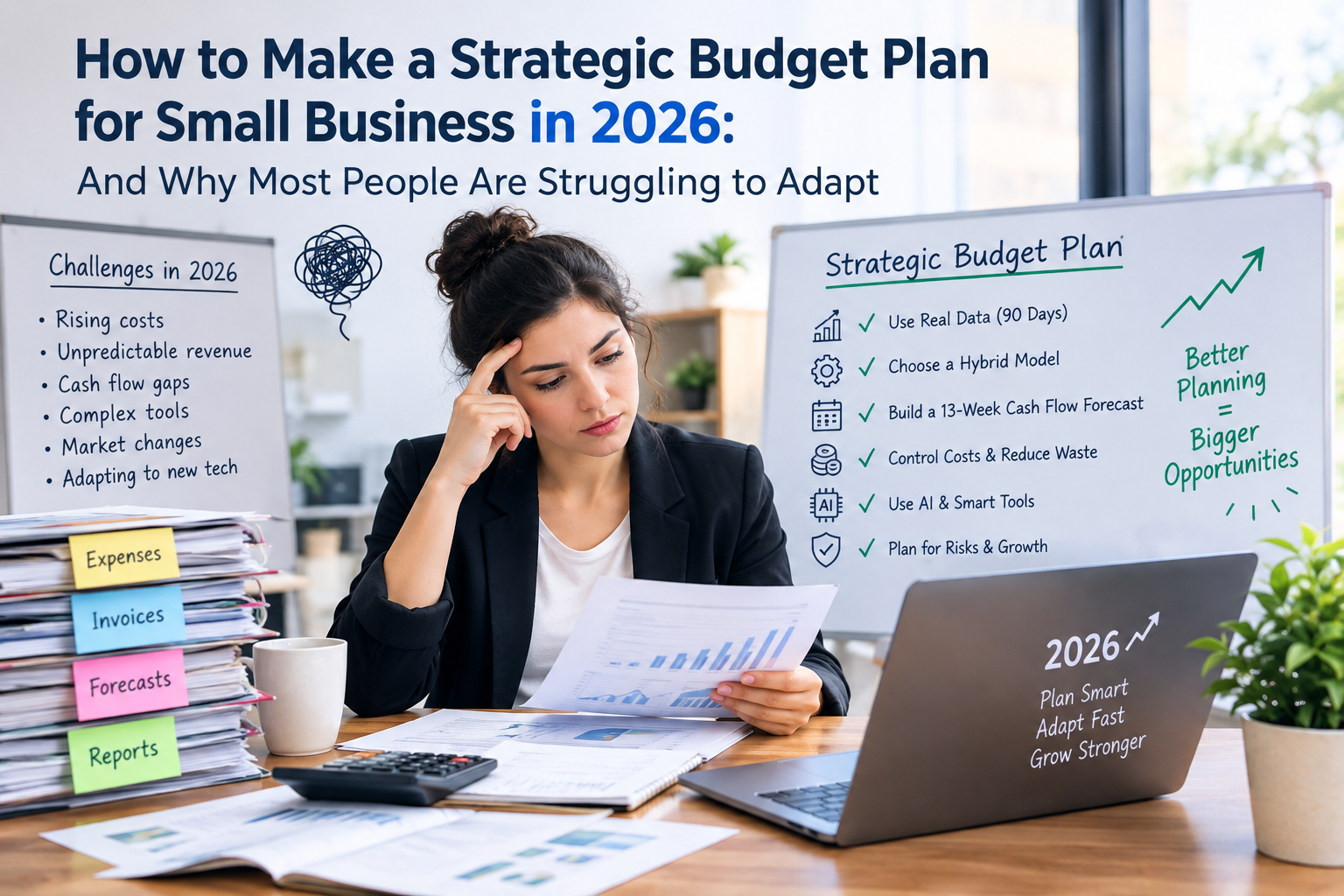
How to Make a Strategic Budget Plan for Small Business in 2026: And Why Most People Are Struggling to Adapt
How to create a business budget in 2026 isn’t fundamentally different from previous years in terms of basic steps. The struggle is in the adaptation.
The Adaptation Gap: What the Data Reveals
The biggest challenge for small business owners is getting financially prepared in anticipating and adapting to customer preferences (43%), followed closely by navigating the complexity of digital tools used to track finances (42%). In other words, the tools that exist to sort out the problem more efficiently is that entrepreneurs don’t know how to use them effectively.
The adaptation struggle is real, and it’s threefold:
- The tool complexity paradox. The use of Artificial Intelligence has grown dramatically 69% as small business owners now use AI to decrease expenses and efforts, up to 39% the previous year. However 87% of specialists ranked AI as extremely important for financial operations while using or implementing the tools remains stuck at 59%.
- The cash flow timing trap. Making profit doesn’t mean that money is available and keeps coming. A rise in demand and supply in the market can affect the cost of goods or sudden fluctuations in market trends regardless of how much profit is made disturbs the investments. Entrepreneurs who focus only on profitability while ignoring these occasional risks are setting themselves up for a liquidity crunch.
- The planning paradox. 88% of businesses recognise the need for a living business plan, yet about one in three don’t have an active plan in progress. Everyone knows they should budget. Far fewer actually do it consistently.
A Strategic Framework for 2026 Budget Planning
Here’s how to prepare a strategic framework for a small business growth that actually adapts to 2026’s conditions:
Step 1: Build from 90 days of actual data, not projections. Establish it on 90 days of real data rather than projections. Actual revenue and expenses reveal trends, seasonal variations and inflationary patterns that projections alone will miss.
Step 2: Using a hybrid budgeting model. The most effective approach blends zero-based budgeting, rolling forecasts, and driver based models
Step 3: Implement a 13-week cash flow forecast. This step is non-negotiable in 2026. As a rolling 13 week forecast that covers sales, inventory, raw material payments, wages, rent, loan and marketing spend which gives you weekly visibility into possible shortfalls before they become emergencies.
Step 4: Plan for multiple scenarios. Do your company budget planning for best case and worst case scenarios which covers every possible payment for the business growth.Thinking through the implications gives you the flexibility to react quickly rather than scrambling.
Step 5: Automate the low-value tasks. AI tools can now categorise expenses, forecast inventory, and even draft financial summaries. The goal isn’t to replace human judgment — it’s to free up hours each week that can be redirected toward customer service, product development, or strategic thinking.
Business Continuity Recovery Strategies Every Entrepreneur Needs in 2026
The small business or startups less than 25% are well prepared for any sudden occurrence of emergency that temporarily blocks operations. In a year defined by supply chain disruptions, cybersecurity threats, and rapid technological change, that’s a vulnerability no entrepreneur can afford.
The Three-Stage Recovery Framework
The most effective business continuity recovery strategies follow three stages: reducing risk, crisis management, and restoring operations.
Stage 1: Reduce Risk Before It Materialises
Determine your key risks by identifying what you want to secure first in case of shortage of material or then outline those threats that could affect your assets. For a product-based business, this might mean diversifying suppliers to avoid single-point failure. For a service business, it could mean maintaining backup communication systems and cloud-based data storage.
Stage 2: Crisis Management Playbook
Every small business should have a documented set of procedures that guides the team through a disruption. This doesn’t need to be a fully long explained documentation. For most small businesses, a 15–25 page plan including appendices is sufficient. The plan should identify critical business functions, establish clear communication procedures, and define first-hour actions.
Stage 3: Restore and Rebuild
Set clear recovery objectives for how quickly operations must resume, and a recovery point objective for how much data loss is acceptable. Review your insurance coverage, audit your resources, and test the plan after any disruption to shorten future recovery times.
Conclusion: Budgeting as a Competitive Weapon
The entrepreneurs who succeed in 2026 aren’t the one with the most innovative products or the biggest addressable markets. They’ll be the ones who treat how to manage a budget in business as a core strategic function not a compliance exercise, but a competitive advantage.
The confidence gap between what small business owners feel about their financial planning and what the data shows about their actual reserves is the single biggest risk faced by entrepreneurs today. Closing that gap requires abandoning the annual budgeting ritual in favour of continuous, flexible, technology and enabled financial management.
Start with a 13-week cash flow forecast. Build a zero-based budget that justifies every expense. Invest in AI tools that free up your time. Plan for scenarios you hope never happen. And remember: a budget isn’t a restriction on your growth — it’s the roadmap that makes growth possible.
The tools exist. The data is clear. The only question is whether you’ll adapt before the market forces you to.