
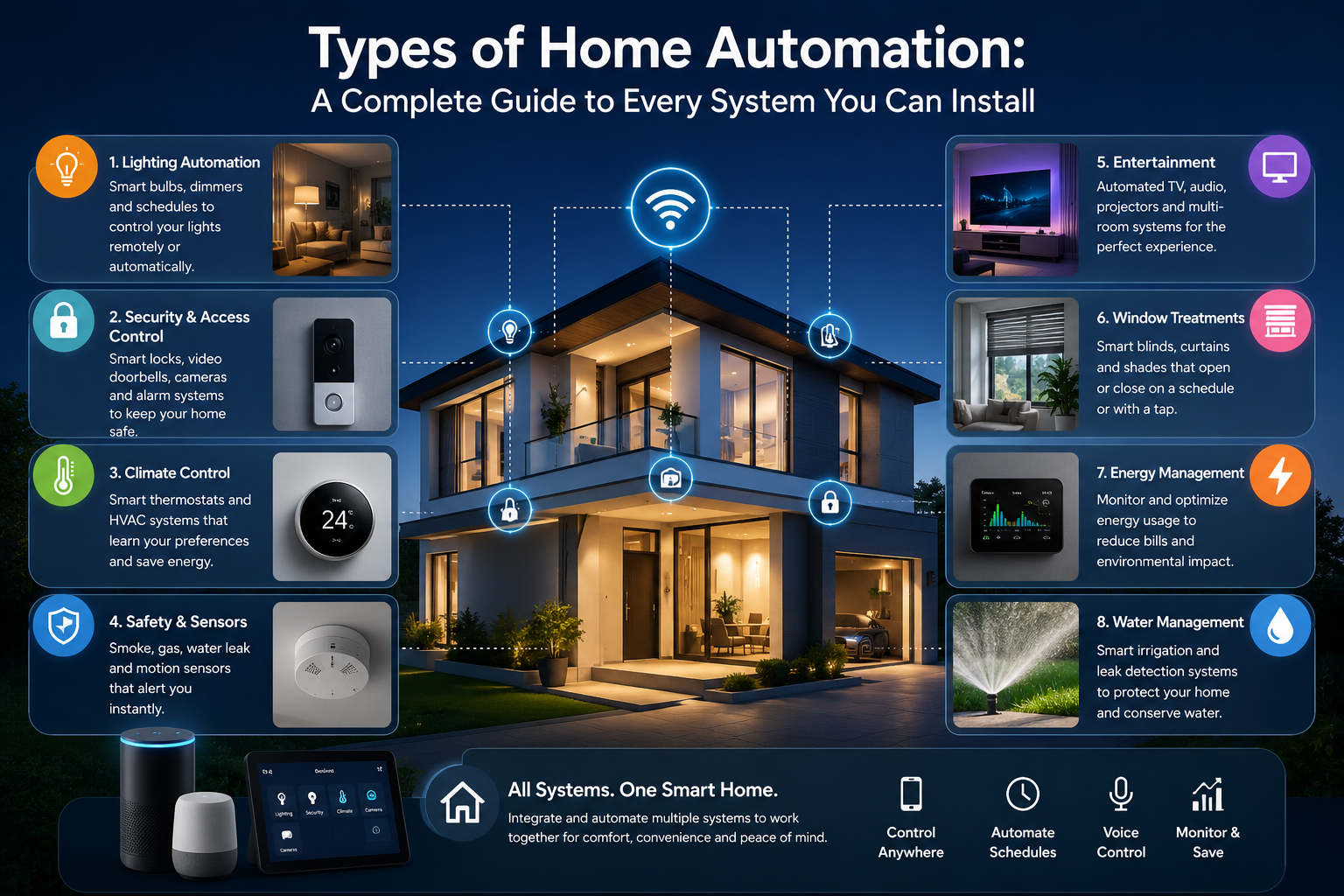

Most people picture voice-controlled lights or a smart thermostat when they think about home automation. But the truth is, modern home automation covers so much more than that. It touches nearly every part of your house, from the locks on your front door to the speakers in your ceiling to the refrigerator keeping your groceries cold. Understanding the different types of home automation is the first step toward turning your house into a space that actually works for you, instead of the other way around.
This guide covers everything. By the time you finish reading, you will know the main categories of home automation, how each one works, what makes them worth investing in, and which type might be the right starting point for your home.
What Is Home Automation, Really?
Home automation is the use of interconnected devices, sensors, and control systems to manage household functions automatically or remotely. Instead of flipping a switch, adjusting a dial, or walking across the house to check a lock, you set up rules and schedules that handle those tasks for you. Some systems respond to your commands through a smartphone app or voice assistant. Others learn your habits over time and make adjustments on their own.
At its core, every home automation system runs on three basic components: sensors that detect conditions in your home, actuators that carry out physical actions like turning a light on or locking a door, and a central controller that connects everything together and acts as the brain of the operation.
The global home automation market was valued at over 114 billion dollars in 2025 and is expected to surpass 266 billion dollars by 2034. That growth tells you one thing clearly: this is not a passing trend. Millions of homeowners are adopting these systems because they work, they save money, and they genuinely make daily life easier.
Now let us look at what those systems actually are.
1. Smart Lighting Automation
Lighting is usually the first thing people automate, and it is easy to understand why. You interact with your lights dozens of times a day. Automating them removes friction from your routine in ways you notice almost immediately.
Smart lighting systems connect your lights to digital platforms through Wi-Fi, Bluetooth, Zigbee, or Z-Wave protocols. Once connected, you can control them from a smartphone app, a voice assistant like Amazon Alexa or Google Assistant, or motion sensors that detect when someone enters a room. You can dim them, change their color temperature, schedule them to follow the sunrise and sunset, or group them into scenes. A “movie night” scene, for example, might dim the living room lights to thirty percent and shift the color to a warm amber all at once, without touching a single switch.
The practical benefits go deeper than convenience. Smart bulbs consume significantly less energy than traditional incandescent bulbs, and automated systems eliminate the waste that comes from forgetting to turn lights off in empty rooms. Homeowners who switch to smart lighting often see noticeable reductions in their electricity bills within the first few months.
Security is another underappreciated benefit of lighting automation. When you are away from home, you can program your lights to follow a randomized schedule that mimics normal activity, making the house appear occupied to anyone watching from outside. Motion-activated outdoor lights also serve as an effective deterrent because most intruders prefer to work in the dark.
Smart lighting systems from brands like Philips Hue, Lutron, and Nanoleaf have made this technology accessible at nearly every budget level. You can start with a few smart bulbs and expand gradually over time, which makes lighting automation one of the most beginner-friendly entry points into the smart home world.
2. Home Security and Safety Automation
Security is the single most adopted category of home automation, holding roughly 26.7 percent of the entire application segment in recent market data. That makes sense. Protecting your home and the people inside it is a fundamental priority, and modern security automation gives you tools that traditional alarm systems simply cannot match.
A fully automated home security setup typically includes smart locks, video doorbells, indoor and outdoor security cameras, motion sensors, door and window contact sensors, glass break detectors, and a central control panel that ties everything together. Each of these devices works independently, but the real power comes when they communicate with each other.
Smart locks are one of the most transformative pieces of this system. They let you lock and unlock your front door remotely, grant temporary access codes to guests or service workers, and receive instant alerts whenever the door is opened. Brands like August, Yale, and Schlage Encode Plus have made these systems reliable enough for everyday use. You will never need to worry about lost keys or forgetting to lock up again.
Video doorbells have become nearly as common as traditional doorbells in newer homes. They stream live footage to your phone, allow two-way audio conversations with whoever is at your door, and many now include AI-powered facial recognition that can distinguish between familiar faces and strangers. Some systems from companies like Ring and Nest go further by integrating AI alarm scoring algorithms that verify genuine threats before sending alerts, which dramatically reduces the number of false notifications you receive.
Motion sensors and door contact sensors feed real-time data into your central hub. You can set rules like “if any door opens after 11 PM and the alarm is armed, turn on every light in the house and send me an alert.” These kinds of chained automations are what separate a true smart security system from a simple camera or alarm.
Smoke detectors, carbon monoxide sensors, and water leak detectors round out the safety side of home automation. A smart water leak detector placed under your sink or near your washing machine can catch a plumbing problem early enough to prevent thousands of dollars in water damage. These devices are inexpensive, easy to install, and genuinely life-saving in the right situation.
3. Climate Control and HVAC Automation
Heating and cooling account for a huge portion of the average household’s energy costs. HVAC automation addresses this directly by putting your climate control on a smarter schedule and giving it the ability to adapt based on conditions inside and outside your home.
The foundation of HVAC automation is the smart thermostat. Unlike older programmable thermostats that followed a fixed schedule regardless of what was actually happening in your home, smart thermostats use occupancy sensors, geofencing technology, and learning algorithms to build a picture of your habits and adjust accordingly. The Nest Learning Thermostat, for example, observes your manual adjustments over the first week of use and then starts making those adjustments on its own.
Geofencing is one of the most practical features in this category. Your thermostat uses your smartphone’s GPS location to detect when you are leaving or approaching home. When you leave, it lets the temperature drift toward energy-saving levels. When you are about ten minutes away, it starts bringing the temperature back to your comfort zone so the house feels right when you walk in. You never have to think about it.
Multi-zone HVAC systems take this further by dividing your home into separate climate zones, each with its own sensors and controls. Instead of heating or cooling the entire house to one temperature, you can keep the bedrooms cooler at night while maintaining a comfortable temperature in the living areas during the evening. This kind of precise control can reduce heating and cooling costs by ten to thirty percent compared to conventional systems, according to HVAC industry data.
Air quality is increasingly part of HVAC automation as well. Smart sensors now monitor humidity levels, particulate matter, CO2 concentration, and volatile organic compounds in real time. When air quality drops below a set threshold, automated systems can trigger ventilation, adjust fan speeds, or alert you to open a window. This is especially valuable for families with young children or members who have respiratory conditions.
In 2026, the most advanced HVAC automation systems are moving toward what specialists call “comfort profiles,” where the system does not just manage temperature but coordinates with your lighting, air filtration, and even your daily calendar to create an environment that matches your needs throughout the day without any input from you.
4. Home Entertainment Automation
Entertainment automation has evolved from a luxury that only high-end custom homes could afford into something accessible to most homeowners. The goal is simple: control your entire entertainment environment from one place and make the experience as seamless and immersive as possible.
A modern home entertainment automation setup starts with a central control system. Platforms like Josh.ai, Control4, and Savant act as the hub that ties together your TV, streaming devices, gaming consoles, audio system, projector, motorized blinds, and even your lighting. Instead of managing six different remote controls, you work from one interface, whether that is an app on your phone, a dedicated touchscreen panel, or a voice command.
Whole-home audio is one of the most popular pieces of this category. Systems from brands like Sonos, VSSL, and Nuvo distribute music to speakers in every room of your house, and you can control what plays where independently. Guests at a dinner party can enjoy one playlist in the dining room while another family member listens to something completely different in the bedroom. The music follows you naturally as you move through the space.
Home theater automation brings the cinema experience into your living room or a dedicated media room. High-resolution 4K and 8K projectors, Dolby Atmos surround sound systems, motorized projection screens that descend silently from the ceiling, and acoustic treatments all work together to create an environment that genuinely rivals a commercial theater. And because it is all automated, pressing a single button called “Movie Time” can lower the screen, dim the lights, close the motorized shades, power up the projector, and launch your preferred streaming service without you lifting more than one finger.
AI is beginning to play a larger role in entertainment automation as well. Systems can now analyze the type of content you are watching and adjust audio settings, room temperature, and lighting color automatically. They track usage patterns and make recommendations. Some integrators are building systems where the home literally sets the stage for your entertainment the moment it detects you settling in for the evening.
5. Smart Appliance Automation
Smart appliances bring automation into the kitchen, laundry room, and throughout the home in ways that directly affect your daily routine. Refrigerators, dishwashers, washing machines, dryers, ovens, and coffee makers are all now available in connected versions that can communicate with your central smart home platform.
A smart refrigerator can monitor its own inventory and send you a grocery list when you are running low on staples. Some models include internal cameras that let you check the contents remotely from the grocery store. Smart ovens can be preheated remotely so dinner is ready to go the moment you get home, and they can adjust cooking times and temperatures based on what you put inside. Smart dishwashers and washing machines let you start or monitor cycles from your phone and can send notifications when a load is done.
The integration between smart appliances and energy management systems is where this category really starts to pay off. Smart appliances can be programmed to run during off-peak electricity hours when rates are lower, which adds up to meaningful savings on your monthly energy bill without requiring any manual effort on your part.
Voice control integration makes smart appliances particularly convenient. Asking your voice assistant to preheat the oven to 375 degrees or to start the dishwasher is genuinely faster than walking over to do it manually, especially when your hands are full or you are in a different part of the house.
6. Energy Management Automation
Energy management is a category that cuts across everything else on this list. It refers specifically to the systems and tools designed to monitor, analyze, and optimize how your home uses electricity, gas, and water.
Smart energy meters and whole-home energy monitors like the Sense Energy Monitor plug into your electrical panel and track the power consumption of individual appliances based on their unique electrical signatures. You can see in real time which devices are drawing the most power and identify patterns that lead to unnecessary waste. Many homeowners discover, for the first time, just how much energy older appliances or devices left on standby are consuming.
Smart plugs and power strips extend this control to any device you plug into them. You can set schedules, monitor energy use, and cut power remotely to devices that should not be running when no one is home. Smart power strips can even detect when a primary device like a TV is turned off and automatically cut power to connected devices like cable boxes and gaming consoles that otherwise continue drawing power in standby mode.
Solar panel systems and home battery storage units like the Tesla Powerwall are increasingly being integrated into home automation platforms. Homeowners can monitor solar production in real time, automatically route excess energy into battery storage for use at night, and manage the balance between grid power, solar, and storage based on electricity rates throughout the day. This level of control is what allows some homeowners to dramatically reduce or even eliminate their electricity bills.
Water management automation is a growing part of this category as well. Smart irrigation systems use weather data and soil moisture sensors to water your lawn only when it actually needs it, eliminating the waste that comes from running sprinklers on a fixed schedule regardless of conditions. Some systems can reduce outdoor water usage by thirty to fifty percent compared to conventional timers.
7. Voice Control and AI-Powered Automation
Voice control deserves its own discussion because it functions as the interface layer that sits on top of every other type of home automation. Platforms like Amazon Alexa, Google Home, and Apple HomeKit connect to devices across all the categories above and let you control them through natural speech.
The simplest use of voice control is direct commands. “Turn off the kitchen lights.” “Lock the front door.” “Set the thermostat to 70 degrees.” But the real value comes from routines, which are sequences of actions triggered by a single command or a specific condition. Saying “good night” to your Alexa device might lock all the doors, turn off every light in the house, lower the thermostat, arm the security system, and start a white noise machine in the bedroom simultaneously. That single command replaces what would otherwise be eight separate actions.
AI is pushing this further in 2025 and beyond. Modern systems are moving past simple rule-based automation into genuinely adaptive environments that learn your preferences and anticipate your needs. The Nest Learning Thermostat was an early example of this, but today’s systems are far more sophisticated. Google Home’s AI can now make predictive suggestions based on your patterns, proactively adjusting settings before you even make a request. Some high-end custom systems from integrators working with platforms like Josh.ai can hold natural conversations, understand context across requests, and coordinate complex scenarios without requiring you to define them in advance.
The barrier to using voice control has dropped significantly. A basic smart speaker from Amazon or Google costs under fifty dollars and can control hundreds of compatible devices out of the box. For households that do not want to invest in a comprehensive hub or controller, a smart speaker plus a handful of compatible devices is often enough to experience the most practical benefits of home automation.
Types by System Architecture
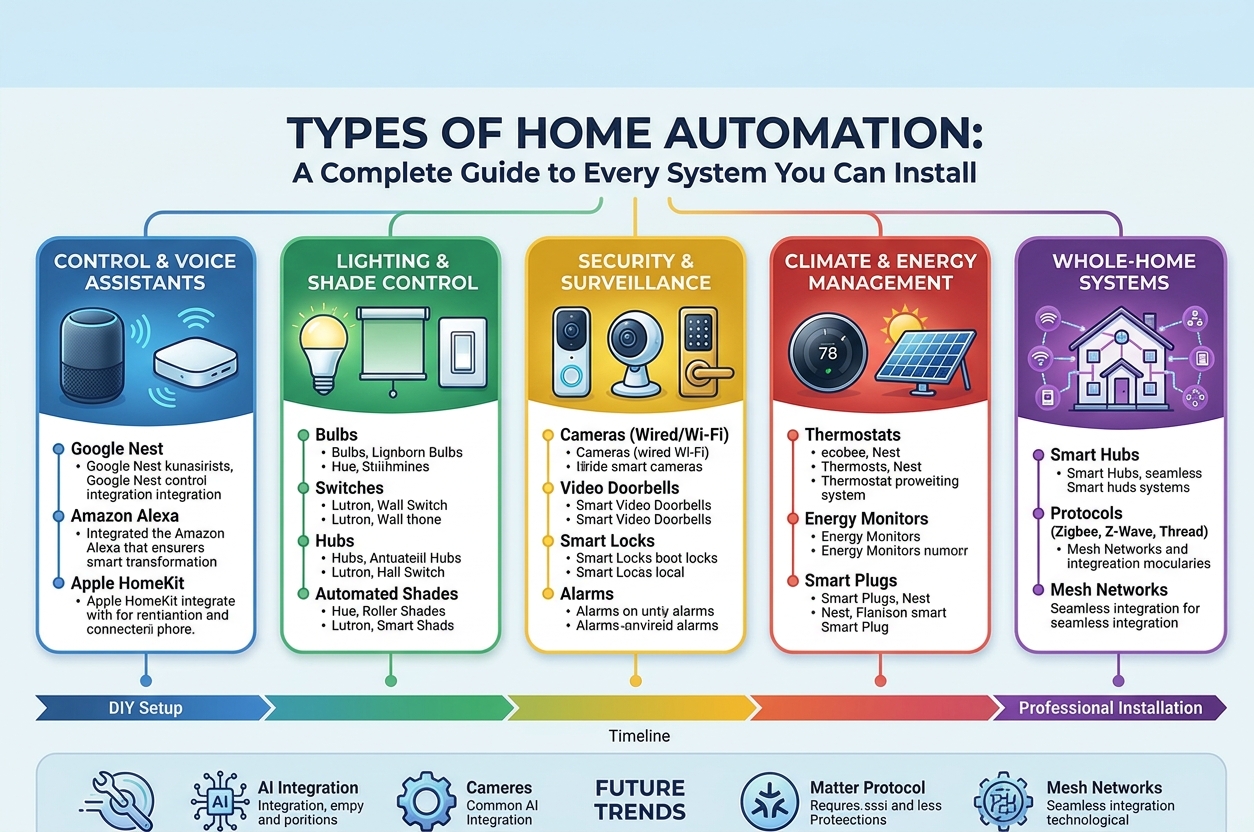
Beyond the categories above, home automation systems also differ in how they are physically set up and connected. Understanding these structural differences helps you choose an approach that fits your home and your willingness to get hands-on with technology.
Wired Systems
Wired home automation systems use physical cables running through the walls to connect devices to a central controller. They are the most reliable option available because they do not depend on wireless signals, which means they are immune to interference, dead zones, and network congestion. Wired systems are ideal for new construction where the cabling can be installed during the building process, and they are commonly found in high-end custom homes. Brands like Lutron, Crestron, and Control4 build professional-grade wired systems that integrators design and install as complete packages.
The main drawbacks are cost and installation complexity. Adding a wired system to an existing home requires opening walls, running cable, and significant labor, which makes it a substantial investment. However, for homeowners building new construction or completing a major renovation, the reliability and performance of a wired system are hard to match.
Wireless Systems
Wireless systems are the dominant choice in the home automation market today because they are far easier to install and much more flexible. They use radio frequency protocols to communicate between devices, with the most common options being Wi-Fi, Zigbee, Z-Wave, and the newer Matter standard that major manufacturers adopted in 2022 to improve cross-brand compatibility.
Wi-Fi devices are the most plug-and-play option since they connect directly to your existing home network. Zigbee and Z-Wave devices form mesh networks where each device relays signals to others, which extends range and improves reliability throughout the home. Matter, developed as a joint standard by Apple, Google, Amazon, and the Connectivity Standards Alliance, is designed to let devices from different brands work together seamlessly without compatibility headaches.
Most consumers starting with home automation are using wireless systems, whether they know it or not. Smart bulbs, smart speakers, video doorbells, and smart thermostats are almost all wireless by design, and they can typically be set up without professional help.
Hybrid Systems
Hybrid systems combine wired and wireless components, using hard-wired connections for the most critical functions like lighting circuits and security panels while relying on wireless devices for more flexible or less critical applications. Many professional integrators recommend hybrid approaches because they deliver the stability of wired systems where it matters most without requiring a full wired installation throughout the entire home.
Types by Installation Approach
DIY Home Automation
DIY home automation refers to systems that homeowners set up themselves using off-the-shelf products. This includes everything from a single smart bulb to a comprehensive self-built setup using platforms like Home Assistant running on a Raspberry Pi. Home Assistant, which is an open-source platform, has become one of the most popular DIY options because it runs locally on your own hardware rather than in the cloud, keeps your data private, and supports an enormous range of devices from different manufacturers. It is genuinely the second most active open-source project on GitHub by some accounts.
DIY systems are the most affordable entry point into home automation and offer a high degree of customization. The trade-off is that they require more time, technical knowledge, and patience to set up and maintain. When something does not work as expected, you are your own tech support.
Professionally Installed Systems
Professionally installed systems are designed and set up by certified integrators who assess your home, design a system around your specific needs and preferences, install and configure all the hardware, and provide ongoing support. Platforms like Control4, Savant, and Crestron are used almost exclusively in professional installations and offer capabilities that go well beyond what is available in consumer-grade DIY products.
These systems handle true whole-home integration, meaning they can coordinate every device in your home through a single, custom-programmed interface. The experience is seamless in a way that is difficult to achieve with DIY setups. The cost is significantly higher, but for homeowners who want a system that works perfectly from day one and continues to work reliably for years without tinkering, professional installation delivers real value.
Managed Home Automation
Managed home automation sits between DIY and full professional installation. A provider installs and maintains the system for you, typically under a monthly service contract that includes monitoring, updates, and technical support. Companies like Vivint and ADT offer managed smart home packages that combine professional-grade security monitoring with smart home features like lighting, locks, and thermostat control accessible through a single app.
Managed systems are a good option for homeowners who want the benefits of automation without the complexity of managing it themselves, and who also want professional security monitoring built into the package.
How to Pick the Right Type for Your Home
No single type of home automation is right for everyone. Your starting point depends on what bothers you most about your current home setup, what your budget looks like, and how much time you are willing to invest in learning and managing a system.
If your main concern is security, start with a smart lock, a video doorbell, and a basic set of motion sensors. These three devices alone will dramatically improve your peace of mind and give you real-time visibility into what is happening at your front door.
If you are motivated by energy savings, a smart thermostat is almost always the single highest-return investment in home automation. Most models pay for themselves within the first year through reduced heating and cooling costs, and installation typically takes under thirty minutes.
If you want to improve your daily routine without a major project, a few smart bulbs paired with a smart speaker can get you started for under a hundred dollars. You will be surprised how quickly you start relying on those automations and wanting to expand them.
And if you are building a new home or completing a major renovation, this is the right moment to think comprehensively. Working with a professional integrator during construction allows you to design a whole-home system that handles everything from lighting and security to entertainment and energy management in an integrated way that is much harder and more expensive to replicate after the walls are closed.
Final Thoughts
Home automation has reached a point where it is no longer a technology reserved for early adopters or people with large budgets. The range of options available today covers every lifestyle, every home size, and every price point. Whether you are installing your first smart bulb or planning a complete custom integration, the types of home automation covered in this guide each offer genuine, practical value that can change how comfortable, safe, and efficient your home feels every single day.
The key is starting somewhere and building from there. Every system you add teaches you something about what works best for your household, and the smarter your home gets, the more you realize how much of your daily friction it can quietly handle on your behalf.




2 Responses
Ótimo post! Gere e edite com GPT Image 2 em Luna Lisa Alpha: . Luna Lisa Alpha