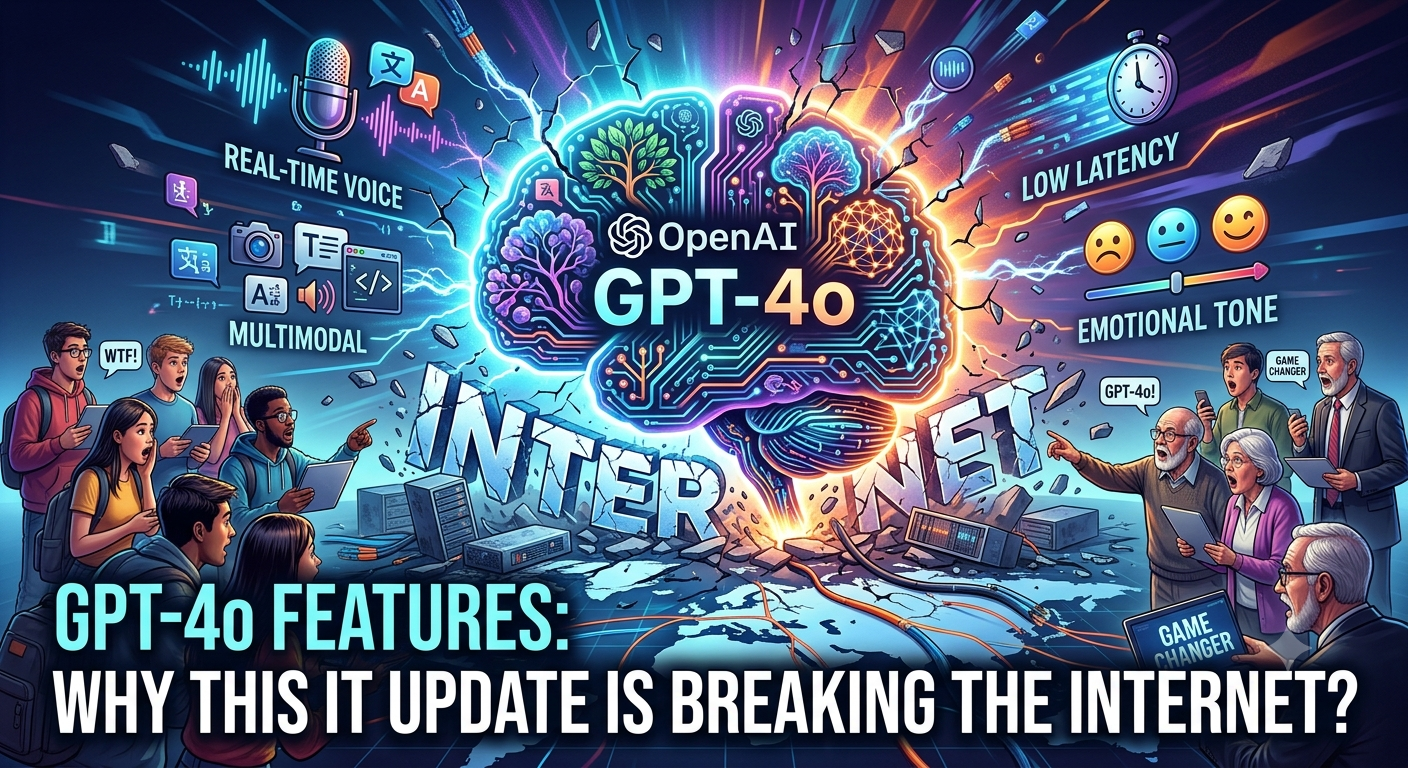

The technological journey is moving at a blistering pace, but every once in a while, a gadget launch forces the entire IT industry to stop and realign. The latest disclosure of OpenAI’s GPT-4o (the “o” signifies omni) is actually that kind of paradigm-transition moment. For IT experts, developers, and everyday users, this is not only another progressive software update. It is a basic rewrite of how people will link with machines, and it is commanding the global tech world.
The Aura of Actual “Omni” Capabilities:
Past loopings of productive AI needed separate models for messages, voice, and picture processing. You would speak, the AI would convert it to text form, work on the text, produce a text reaction, and ultimately change that back into voice. This clunky beit bart process created actual lags and lost emotional nuance.
GPT-4o can entirely destroy this bottleneck. It is naively multimodal, signifying it can listen, see, and speak all simultaneously. For the IT department, this main working capability gets rid of the complicated backend API integrations that are ultimately needed to stitch together AI models. The arrangement can now read a live video feed from a surveillance camera, examine the voice of a breaking event, and verbally report the thing to a user with zero delay or lag.
Why IT Experts Are Paying Attention?
When a new AI model drops, businesses in the IT world instantly ask two main questions: How safe is it, and how much will it cost to incorporate? OpenAI has explained that GPT-4o is double fast and fifty percent less expensive to run through the API than its previous version, GPT-4 Turbo.
This price brought down is a big headline for chief technology officers. It stands that highly complicated, AI customer service agents, which were actually too expensive to execute at scale, are just financially available for average business organizations. Moreover, the model’s power to check live screens and code is positioned to drastically speed up software development cycles. IT information officers are already seeking to rearrange GPT-4o as a gut instinct, voice-activated tier-one backup support that can actually see a user’s screen to troubleshoot problems.
The Transition in the Aggressive IT World:
OpenAI did not bring this out in a space. The shift of GPT-4o is a direct, competitive strike at rivals such as Google, which previously rushed to incorporate its Gemini model into workspace apps. It as well puts huge pressure on Apple, which is expected to declare its own AI partnerships this summer season.
Across the board, the IT base is signaling that the “text-only chatbot” time is formally dead. The next step of enterprise software is voice-first, virtually aware, and fast. Companies that are presently building up text-based AI tools will quickly be outpaced by rivals who buy these fresh omni-capable models.
Winding Up:
The introduction of OpenAI’s GPT-4o shows a big leap from theoretical AI towards active one, real-time utility. By blending voice, vision, and text into a single, super-fast model, OpenAI has created a tool that will reshape software development, cybersecurity, and customer experience. For technology websites and IT experts, likewise.