
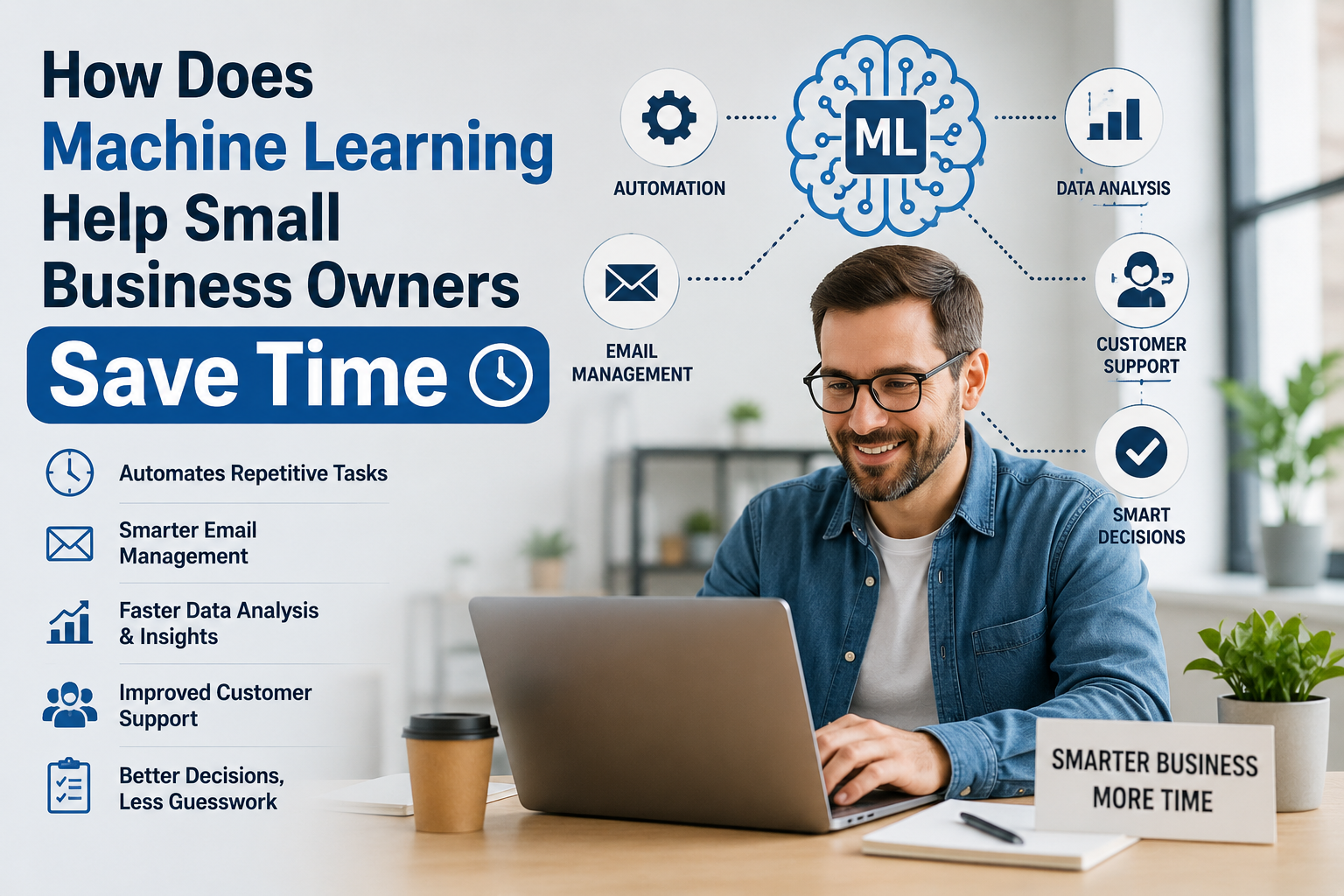

Running a small business is one of those things that sounds freeing until you are actually doing it. You thought you would be spending your days building something meaningful, connecting with customers, and growing a team. Instead, you find yourself answering the same emails for the hundredth time, manually updating spreadsheets, chasing invoices, and trying to remember whether you ordered enough stock for next month. The hours disappear before you even realize where they went.
This is the real problem most small business owners face. It is not a lack of ambition or strategy. It is time. There are only so many hours in a day, and when most of those hours go toward tasks that feel more mechanical than meaningful, the business stops growing and the owner starts burning out.
Machine learning has quietly changed this equation. And the interesting thing is, most people still think it belongs only to big tech companies with massive engineering teams and multimillion-dollar budgets. That could not be further from the truth. Today, machine learning is woven into tools that small businesses already use every single day, and it is saving owners real hours every single week.
This article breaks down what machine learning actually does, where it fits inside a small business, and how it frees up the time that owners desperately need to focus on what actually matters.
What Machine Learning Actually Is, Without the Jargon
Before diving into how it helps, it makes sense to get clear on what machine learning is. Not the textbook definition, but the practical one.
Machine learning is a type of software that learns from data to get better over time. Instead of being given a fixed set of rules to follow, it looks at patterns in information and starts making predictions or decisions based on what it sees. The more data it works with, the more accurate it becomes.
Think about a spam filter in your email. Nobody programmed it to block every single spam message individually. Instead, it learned from thousands of examples of what spam looks like, and now it catches it on its own. That is machine learning at its most basic. It is a system that figures things out from experience rather than relying entirely on a human to spell out every single step.
For a small business owner, this matters because there are dozens of tasks happening every day that follow recognizable patterns. Customers ask similar questions. Sales go up during certain seasons. Invoices tend to come in at predictable times. When a system can recognize those patterns and act on them automatically, the owner does not have to.
The Time Problem Is Real, and the Numbers Back It Up
Before getting into the specific ways machine learning saves time, it helps to understand the scale of the problem.
Research from BCG found that more than 40 percent of workers spend at least a quarter of their workweek on repetitive, manual tasks that could be partially or fully automated. Nearly 60 percent of those same workers believed they could save six or more hours every week if those tasks were handled by automation. For a small business owner wearing five different hats at once, six hours a week is enormous.
According to the U.S. Chamber of Commerce, more than 80 percent of small businesses that adopted AI tools in 2025 reported higher sales, increased profits, and growth in their teams. A Google Workspace report highlighted one business owner who saved 20 hours a week on paperwork alone after integrating machine learning into her stock tracking process. That is essentially a part-time job worth of time given back to her.
The point is that this is not theoretical. The time savings are measurable, and they show up in businesses of all sizes, industries, and budgets.
Automating the Tasks That Eat Up Your Day
The most direct way machine learning saves time for small business owners is through automation of repetitive tasks. These are the tasks that happen over and over again, follow a clear pattern, and require no real creativity or judgment to complete. They are also the tasks that quietly consume hours every week without the owner even tracking how much time they take.
Customer email responses are a perfect example. Most small businesses receive a consistent stream of similar questions. What are your hours? Do you offer refunds? How long does shipping take? Without automation, someone has to read each one and type out a reply. With machine learning-powered tools, the system reads the incoming message, understands what the customer is asking, and sends back a relevant, natural-sounding response in seconds. This is not a pre-written script that fires back the same message every time. These systems actually understand context and get better at responding the more they interact with customers.
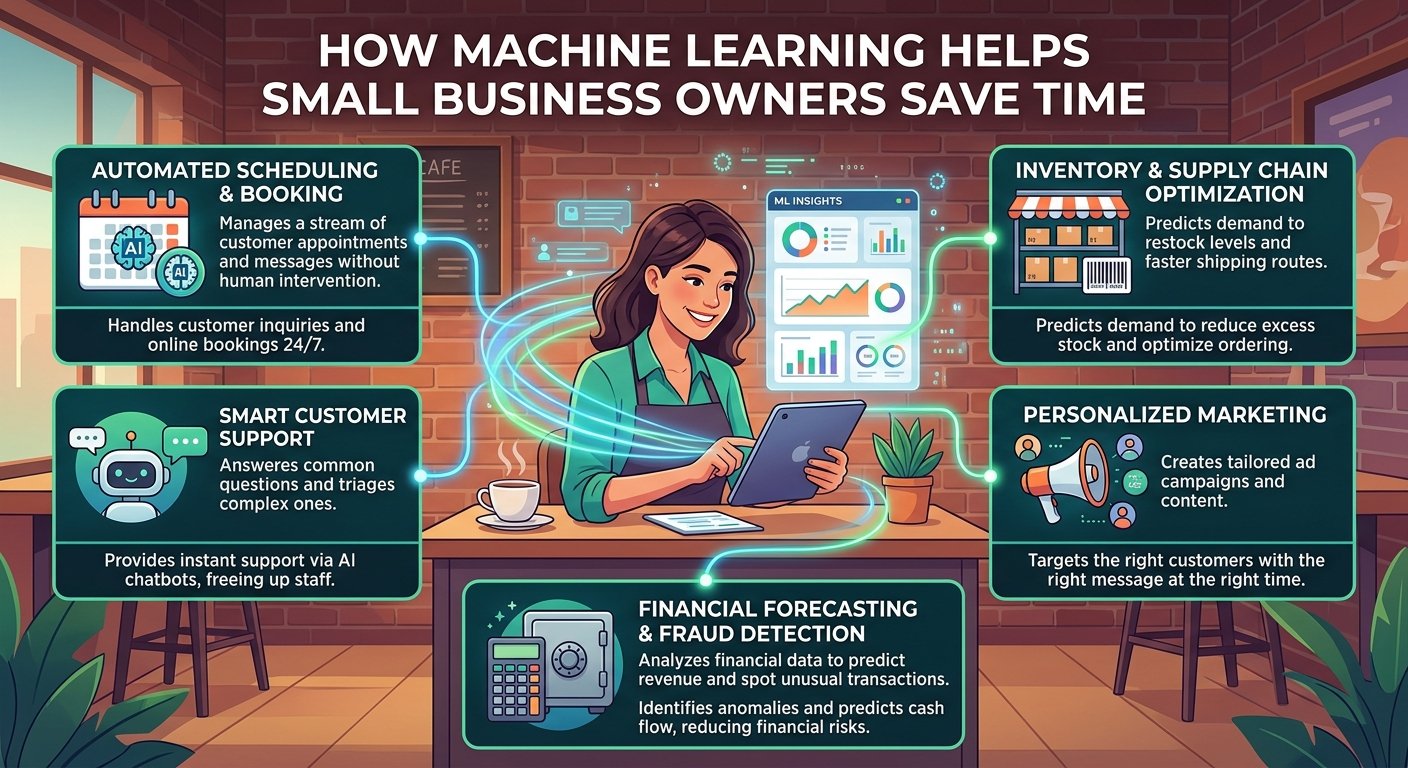
The same principle applies to appointment scheduling. A business owner who takes consultations or service bookings used to have to go back and forth with clients, checking availability, confirming times, and sending reminders. Scheduling tools built on machine learning handle all of that automatically. They read availability, offer open slots, confirm bookings, and send reminders without the owner touching anything.
Data entry is another massive time sink. Whether it is updating customer information in a database, entering sales figures into a spreadsheet, or logging inventory changes, this kind of work is both boring and mistake-prone when done by hand. Machine learning tools can pull this information from receipts, orders, and other documents and enter it accurately without human involvement.
Customer Service That Does Not Require You to Be Available Around the Clock
Customer service is one of the biggest challenges for small businesses. Customers want fast responses, but a small team cannot realistically be available at all hours of the day.
Machine learning changes this through what are commonly called AI-powered chatbots and virtual assistants. These are not the clunky, frustrating bots of ten years ago that responded with confusing menus and missed the point of every question. Modern versions are trained on real conversations and can handle nuanced questions with genuine accuracy. They understand when someone is asking about a return, when they are complaining about a product, and when they just need basic information.
What matters for time savings is that these tools handle the majority of incoming customer inquiries without any human involvement at all. This means the business owner and their team only need to step in for truly complex or sensitive situations. The routine stuff is handled automatically, consistently, and at any hour.
Beyond chatbots, machine learning also helps with something called sentiment analysis. As customers leave reviews, send emails, or post comments online, these tools scan the language and flag messages that carry frustration, urgency, or dissatisfaction. Instead of manually reading through everything, the owner can immediately see which customers need attention, which products are generating complaints, and what patterns are emerging in feedback. That kind of awareness used to require hours of reading and sorting. Now it happens automatically.
Inventory That Manages Itself (Almost)
For retail shops, restaurants, and product-based businesses, inventory management is one of the most time-consuming and costly responsibilities an owner faces. Order too much and money is tied up in unsold stock taking up shelf space. Order too little and customers walk away empty-handed and frustrated.
Traditional approaches relied heavily on gut feeling, past experience, and manually reviewing sales reports. Machine learning removes most of the guesswork by analyzing historical sales data, seasonal patterns, customer purchase trends, and even external factors like local events or weather conditions to predict exactly what stock will be needed and when.
The result is that reordering happens automatically based on real forecasted demand rather than someone sitting down to check numbers and make a call. One e-commerce business described in industry research had been guessing its inventory levels manually and regularly ended up with 30 percent overstock during slow months and consistent stockouts during peak season. After implementing machine learning forecasting, both problems dropped significantly because the system understood the patterns far better than manual tracking could.
For a small business owner, this means fewer hours spent reviewing stock levels, fewer panic orders, less wasted money on surplus inventory, and more time available for everything else.
Marketing That Knows Who to Talk to and When
Marketing is another area where small business owners tend to pour time into work that produces inconsistent results. Sending out the same email to every customer on a list, posting on social media at random times, or running the same promotion to everyone regardless of what they actually want is both inefficient and ineffective.
Machine learning analyzes customer behavior, purchase history, browsing habits, and engagement patterns to understand what individual customers are interested in and when they are most likely to respond to a message. This makes it possible to send the right content to the right person at the right time, without the owner manually segmenting lists and crafting personalized campaigns by hand.
Tools like Mailchimp and HubSpot already have these capabilities built in. They track how customers interact with emails, which subject lines generate opens, which products get clicked, and which promotions convert. Over time, the system learns what works for each audience segment and adjusts automatically. The owner does not have to analyze campaign performance reports and make manual changes every week. The tool does it.
This also extends to ad targeting. Instead of spending time researching audiences and manually adjusting ad parameters, machine learning platforms study which customer profiles actually convert and optimize targeting in real time. Business owners who used to spend hours managing paid advertising have shifted to reviewing results rather than managing every detail.
Smarter Financial Decisions Without the Spreadsheet Headaches
Bookkeeping and financial management are tasks most small business owners either dread or delegate, and usually both. Machine learning has made tools like QuickBooks far more capable than simple accounting software. They now automatically categorize expenses, match transactions to invoices, flag unusual activity, and generate cash flow projections based on historical patterns.
This matters for time savings in a very direct way. Instead of spending an afternoon sorting through bank statements and manually categorizing transactions, an owner can open their dashboard and see a clear picture of where money came in and went out, already organized and ready to review. Reconciling accounts at the end of the month goes from a multi-hour task to a quick review.
Beyond the basic bookkeeping, machine learning tools can also help business owners make smarter financial decisions by predicting upcoming cash flow gaps based on payment trends, seasonal cycles, and outstanding invoices. Knowing a week in advance that a tight month is coming allows an owner to act rather than react.
Making Decisions Faster Because the Data Does the Heavy Lifting
One of the less obvious ways machine learning saves time is in the area of decision-making. Small business owners make dozens of decisions every single day. Which leads should they follow up with? Which products need a price adjustment? Which hours should additional staff be scheduled? Which marketing channel deserves more budget?
Without machine learning, answering these questions requires pulling data from multiple places, analyzing it manually, and making a call based on whatever information can be reviewed in the time available. That process can take hours for decisions that need to be made quickly.
Machine learning collapses that timeline dramatically. As one example described in industry research, what used to take three hours of manual analysis now happens in thirty seconds because the system is already watching the right data, identifying patterns, and surfacing recommendations automatically. The business owner still makes the final call, but the background work of gathering and interpreting data is already done.
This is particularly powerful for pricing decisions. Machine learning can track how demand changes at different price points, when competitors adjust their prices, and which customer segments are price-sensitive versus willing to pay more. Instead of researching and adjusting prices manually, owners get recommendations that are grounded in actual data rather than assumptions.
Tools Small Businesses Are Already Using That Contain Machine Learning
One of the most important things to understand about machine learning and small businesses is that you do not need to hire a data scientist or build something from scratch. Most of the popular tools that small businesses already subscribe to have machine learning baked into them.
Shopify uses machine learning to power product recommendations, analyze customer behavior, and support inventory planning. QuickBooks Online uses it for automated categorization, financial insights, and fraud detection. HubSpot uses it for lead scoring, email timing optimization, and customer relationship insights. Mailchimp uses it to predict optimal send times and segment audiences based on behavior. Canva uses it to help businesses create polished visual content faster.
The practical message is that if you are already paying for these tools and not using their AI-powered features, you are leaving significant time savings on the table. Getting started does not require a technical background. It requires spending a couple of hours exploring what the tools you already have can actually do.
A Realistic Look at What Machine Learning Cannot Do (Yet)
It would be unfair to write an article like this without acknowledging where machine learning still has limits when it comes to small businesses.
It is not a replacement for human judgment in situations that require empathy, context, or nuanced understanding of relationships. A machine learning tool can draft an email, but deciding whether to send it in a sensitive business situation should still involve a human. A chatbot can handle routine inquiries, but a customer who is truly upset and needs to feel heard should eventually talk to a person.
It also needs good data to work well. If a business has been operating for only a few months, there may not be enough historical information for predictive tools to draw meaningful conclusions from. Over time, as more data accumulates, the systems become more accurate and useful. But in the early stages, they need to be watched carefully and validated against real-world results.
And perhaps most importantly, machine learning is a tool, not a strategy. Adopting it without a clear sense of which specific problems it is solving can lead to adding complexity without gaining much benefit. The businesses that get the most value from it are the ones that identify their biggest time drains first and then find the right tool to address each one.
How to Start Saving Time with Machine Learning This Week
Getting started does not require a massive investment or a complete overhaul of how the business operates. The most practical approach is to pick one area of the business where time is being lost to repetitive tasks and find a tool that addresses that specific pain point.
If customer service emails are consuming two hours a day, explore a chatbot or AI email assistant. If inventory guesswork is costing money and time, look into the demand forecasting features already built into your inventory software. If bookkeeping takes half a day every week, spend an hour setting up the automated categorization features in your accounting tool.
The goal is not to do AI for its own sake. The goal is to take back the time that is currently going toward tasks a machine can handle, and redirect that time toward the parts of the business that actually require a human being to show up.
The Bottom Line
Machine learning is not a futuristic concept reserved for technology companies with engineering departments. It is a practical, already-available set of tools that helps small business owners stop spending their best hours on their worst tasks.
The research is clear. Businesses that adopt these tools save meaningful time, reduce costly errors, respond to customers faster, manage inventory more efficiently, and make better decisions with less effort. The average savings run into multiple hours per week, and for some owners, that has meant the difference between a business that grinds forward and one that actually grows.
The technology is no longer the barrier. It is accessible, affordable, and in many cases already embedded in the software you are already using. The only thing left to decide is which problem you want to solve first.





One Response
Interessante. Vídeo IA: MiniMax H3 Video Generator /. MiniMax H3 Video Generator