
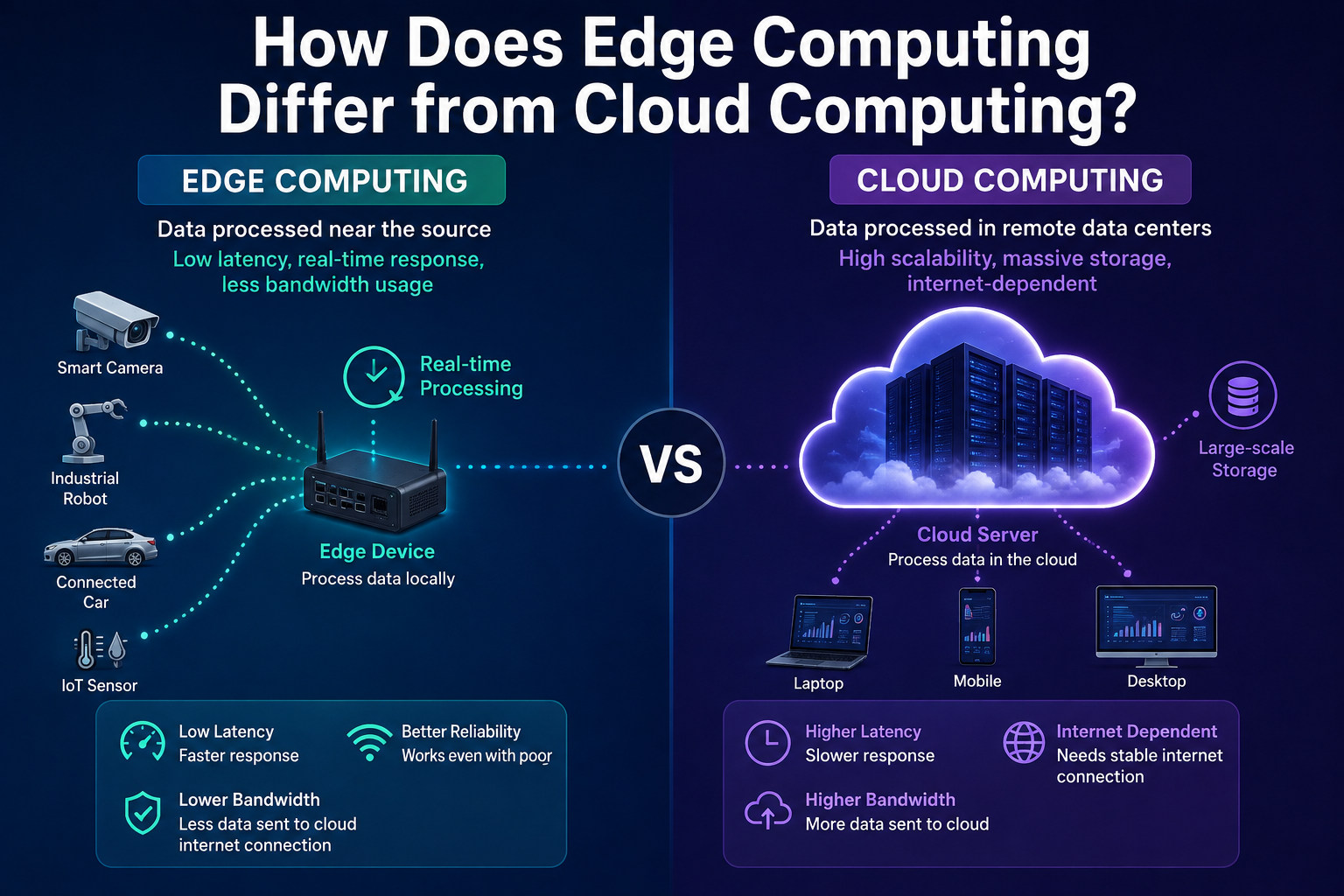

There is a moment every tech conversation eventually hits where someone says “just send it to the cloud” and everyone nods along like they fully understand what that means. But the cloud is not the only option anymore. A different approach called edge computing has been quietly changing the way data moves, and the two technologies work in ways that are more different than most people realize.
This is not a competition between two rivals. It is more like two tools in the same toolbox, each built for a specific job. Understanding how edge computing differs from cloud computing helps you see why certain technologies around you behave the way they do, whether it is your car braking before you even react, a hospital machine sending an alert in seconds, or a simple video call loading without a single stutter.
What Is Cloud Computing and How Did It Take Over Everything?
Before getting into the differences, it helps to understand what cloud computing actually is. At its core, cloud computing means storing and processing data on remote servers that are accessed over the internet. Instead of running software on your own device or maintaining physical servers in an office basement, you rent computing power from a provider who runs massive data centers somewhere in the world.
Companies like Amazon, Google, and Microsoft built enormous facilities packed with servers, and they made those resources available to businesses and individuals on a pay-as-you-go model. Need more storage today? You get it. Need less next month? You scale back. That flexibility made cloud computing one of the most transformative technologies of the last two decades.
Cloud computing is ideal for tasks that demand enormous amounts of storage, global accessibility, and complex processing that does not need to happen in a split second. Think about Netflix streaming a movie, a company running payroll for thousands of employees, or a startup launching an app to users in thirty different countries. The cloud handles all of that without breaking a sweat.
The only catch is distance. When your device sends data to a cloud server, that data might travel hundreds or even thousands of miles to reach a data center, get processed there, and travel all the way back. For most everyday tasks, that round trip happens so fast it feels instant. But for some applications, even a fraction of a second is too long to wait.
What Is Edge Computing and Why Does It Exist?
Edge computing was built to solve exactly that problem. Instead of sending data to a faraway data center, edge computing moves the processing power closer to where the data is actually being created. The word “edge” refers to the edge of the network, meaning the physical location where devices and sensors generate data.
In practice, this could mean a small server installed inside a factory, a computing unit mounted on a cell tower, or even the processor inside your smartphone. When data is processed locally or near the source, it does not need to make that long round trip to a centralized cloud server.
The result is speed that cloud computing simply cannot match for certain tasks. Edge computing can achieve response times as low as 5 to 10 milliseconds, while cloud computing typically introduces delays of 30 to 60 milliseconds or more. For a self-driving car traveling at highway speed, the difference between those response times could mean the difference between a smooth stop and a collision.
Edge computing is not new in concept, but it has grown rapidly because of two things happening at the same time. First, there are now billions of devices generating data every second, from smartphones and security cameras to industrial sensors and medical monitors. Second, more and more applications need to react to that data instantly. Cloud computing cannot always keep up with that demand, which is why edge computing has stepped in.
The Core Difference: Where the Work Happens
The single most important difference between edge computing and cloud computing comes down to location. With cloud computing, the work happens far away in a centralized data center. With edge computing, the work happens near the data source.
This geographic distinction sounds simple, but it has a cascading effect on nearly every other aspect of how these systems perform. Latency, bandwidth usage, cost, security, and reliability all change depending on whether you process data locally or ship it across the country first.
In a cloud architecture, every piece of data from a connected device gets sent to a central hub. That hub processes everything and sends results back. This works beautifully when you are storing a large file, analyzing sales data from the past quarter, or running a machine learning model on millions of records. None of those tasks are time sensitive in a way that makes a few extra milliseconds painful.
In an edge architecture, a portion of the processing stays close to where the data originates. A smart security camera, for example, does not need to upload hours of footage to a cloud server just to check whether someone walked into the frame. It can analyze the video right there at the camera level, and only send a relevant clip or alert to the cloud when something actually happens. That local filtering saves bandwidth, saves money, and saves time.
Latency Is Where the Gap Is Most Obvious
Latency is the technical term for the delay between when data is sent and when a response comes back. In everyday language, it is the lag. It is why a video call freezes for a moment, why an online game stutters, or why a command sent to a device takes a second longer than it should.
Cloud computing has a latency problem that is tied to physics. Light travels fast, but it does not travel instantly. When data has to move from a sensor in Tokyo to a server in Virginia and back, even the best networking infrastructure adds up delay. For tasks like email, file storage, or running a business analytics dashboard, that delay is invisible. For tasks that require real-time reaction, it is a dealbreaker.
Edge computing almost eliminates that problem. Because the processing happens nearby, sometimes on the device itself, the data barely has to travel at all. For autonomous vehicles, this matters enormously. A self-driving car relies on sensors that generate gigabytes of data every second. If that data had to travel to the cloud for processing, the car would be making decisions based on information that is already outdated. By processing sensor data at the edge, the vehicle can react in real time.
The healthcare industry has seen a similar shift. Wearable monitors that track heart rate, oxygen levels, and blood pressure can detect an emergency and trigger an alert within milliseconds when they process data locally. If that same data had to make a round trip to a cloud server, the delay could matter in a medical emergency.
Bandwidth and Cost Work Differently in Each System
One of the less talked about differences between edge and cloud computing is how each one handles bandwidth, and what that means for cost over time.
Cloud computing is built on constant data transfer. Devices send raw data to the cloud, the cloud processes it, and results come back. When you have thousands of devices all doing this continuously, the volume of data moving across the network becomes massive. Bandwidth is not free, and neither is the data storage that comes on the other end. Cloud pricing models are usually flexible, but costs can climb quickly when an organization scales up.
Edge computing changes that equation by filtering data before it ever leaves the local environment. Instead of sending everything to the cloud, an edge system processes data locally and only sends the relevant parts onward. A factory floor with hundreds of sensors does not need to upload every single reading to a cloud server. It processes those readings locally, identifies anything unusual, and sends only the meaningful alerts or summaries to the cloud for further analysis. That dramatically reduces the amount of data traveling across the network, which cuts bandwidth costs.
The tradeoff is upfront investment. Setting up edge computing infrastructure requires physical hardware at multiple locations, and that hardware has to be maintained. Cloud computing avoids most of those upfront costs because the provider handles the infrastructure. For organizations that need to deploy edge nodes across dozens or hundreds of locations, the initial capital cost can be significant, even if the long-term operational savings eventually make up for it.
How Scalability Compares Between the Two
Scalability is one area where cloud computing has a clear advantage. When a cloud-based application needs more processing power, more storage, or wider geographic reach, a business can expand those resources almost instantly through a provider. There is no waiting for hardware to arrive, no installation crews, and no reconfiguring physical infrastructure. A few clicks in an admin panel and resources go up or down as needed.
This kind of elastic scalability is one of the biggest reasons cloud computing became the default architecture for so many businesses over the past decade. A startup can launch with minimal cloud resources, and if the business grows explosively, it simply increases its cloud footprint to match.
Edge computing does not scale the same way. To add more edge computing capacity, you often need to physically install new hardware in new locations. That takes time, money, and planning. On the other hand, edge computing has its own kind of distributed scalability. Because edge systems are spread across many locations by design, the network can route processing to whichever edge node has available capacity. If one edge server gets overloaded, a nearby one can pick up the slack.
Security Looks Different on Each Side of the Equation
Security is one of the most misunderstood aspects of this comparison, because both cloud computing and edge computing have genuine security strengths and weaknesses.
Cloud computing concentrates sensitive data in data centers that are managed by professional security teams with enormous resources. Major providers invest heavily in physical security, encryption, compliance certifications, and automated threat detection. If you are a small organization that cannot afford a dedicated security team, storing data in a well-managed cloud environment is often safer than trying to secure your own infrastructure.
The vulnerability of cloud computing is that centralization creates a high-value target. A breach at a major cloud provider could expose data from thousands of clients simultaneously. And any data traveling between a device and a distant cloud server passes through multiple network points, each of which represents a potential interception risk.
Edge computing reduces that exposure by keeping data closer to where it was created. Sensitive medical records processed at a hospital do not need to travel across the internet to a cloud server. Financial transaction data processed on-site at a bank branch does not travel through external networks where it could be intercepted. This localization reduces what security professionals call the attack surface, meaning there are fewer points where someone could potentially intercept or compromise the data.
The downside is that edge computing spreads hardware across many physical locations, and each of those locations is a potential vulnerability. Managing security across hundreds of edge nodes is much more complex than managing a single centralized system. Firmware updates, hardware tampering, and inconsistent security practices across distributed sites are all real challenges that cloud computing largely avoids by keeping everything in one professionally managed place.
Connectivity and What Happens When the Internet Goes Down
There is a practical difference between edge and cloud computing that does not get discussed often enough, and it comes down to what happens when the internet connection drops.
Cloud computing depends entirely on a stable internet connection. If your connection goes down or becomes unstable, applications running in the cloud stop working properly. For a business that relies on cloud-hosted software, a network outage is an operational crisis.
Edge computing can function without a constant connection to the cloud. Because processing happens locally, an edge system can keep running even when the central internet link goes down. When connectivity returns, the system syncs with the cloud and sends along any data that needs to go there. This offline capability is not just a convenience. For certain industries and locations, it is essential.
An oil rig operating far offshore cannot always guarantee a reliable satellite connection to a cloud server. A remote mine or a ship at sea faces the same challenge. A rural hospital that serves communities with inconsistent internet infrastructure needs systems that keep working regardless of what is happening with the network. In all of these cases, edge computing provides a reliability that cloud-first architectures cannot guarantee.
Real World Examples That Make the Difference Click
Understanding these differences becomes much easier when you look at where each technology is actually being used.
Cloud computing is behind almost every large-scale software product you use. When you stream music or video, when you collaborate on a shared document with someone across the world, when your email syncs across every device you own, that is all cloud computing. When a retailer runs its inventory management system, when a company processes customer data to improve its marketing, when a researcher runs simulations on years of climate data, the cloud is doing the heavy lifting.
Edge computing is behind the things that need to happen right now, with no room for delay. Autonomous vehicles use edge processing to analyze sensor data and make driving decisions without waiting for a cloud roundtrip. Smart manufacturing plants use edge systems to monitor machinery in real time, predicting equipment failures before they happen and preventing costly downtime. Hospitals use edge infrastructure to monitor patients continuously and trigger alerts the moment a vital sign crosses a danger threshold.
Even simpler examples exist around you. When your voice assistant responds faster on newer devices than older ones, part of that is on-device edge processing. When a smart thermostat adjusts your home temperature based on patterns it learns locally, that is edge computing. When a security camera only stores footage when motion is detected rather than recording everything, the camera is performing edge-level processing to make that decision.
Should You Choose One or the Other?
Here is the honest answer: most organizations do not choose one or the other. They combine both in what is often called a hybrid approach, and it has become the most common architecture for businesses that take data seriously.
Time-critical tasks that need instant responses run at the edge. Large-scale data storage, complex analytics, long-term processing, and global accessibility stay in the cloud. An edge system handles the urgent decisions, then sends summarized or filtered data to the cloud for deeper analysis and long-term storage.
A manufacturing company might use edge computing to monitor machines on the factory floor in real time, catching potential failures before they happen. That same company uses cloud computing to store months of production data, run analytics on trends, and generate executive reports. Both systems serve the company, but they serve it differently.
The rise of 5G networks is making this hybrid model more powerful because faster wireless connectivity makes it easier for edge devices to communicate with cloud systems when they need to. As artificial intelligence and machine learning become more embedded in everyday technology, the ability to run AI models at the edge without waiting for cloud servers is becoming a major competitive advantage for industries that depend on speed.

What the Future Looks Like for Both Technologies
The global cloud computing market reached over 700 billion dollars in 2025, and it continues to grow. Edge computing is a smaller but fast-moving market, with global spending projected to grow rapidly through the rest of this decade. Neither technology is going away, and neither is replacing the other.
What is changing is how they are being used together. The conversation has shifted from “cloud versus edge” to “cloud and edge, designed intelligently.” Engineers and technology leaders are increasingly asking not which one is better, but which one is better for this specific workload, this specific use case, and this specific set of performance requirements.
For anyone who wants to understand how modern technology works, grasping the difference between edge and cloud computing is not just helpful. It is essential. These two approaches form the foundation of how data moves, gets processed, and powers the applications and services that run almost every part of modern life.
Closing Thoughts
Edge computing and cloud computing are not rivals. They are partners with different strengths, and the best technology decisions come from knowing when to lean on each one. Cloud computing offers unmatched scalability, centralized management, and the ability to store and process enormous volumes of data without maintaining your own infrastructure. Edge computing offers speed, reduced bandwidth costs, offline reliability, and the ability to act on data before it ever leaves the place where it was created.
The next time your phone responds to a command in what feels like no time at all, or a piece of factory machinery catches its own problem before a human notices, that is the edge at work. And the next time you access a shared document from a hotel room in another country or stream a video in crystal-clear quality, that is the cloud doing what it does best.
Both matter. Both will keep growing. And understanding how they differ from each other puts you ahead of most people who still just nod along when someone says “send it to the cloud.”




One Response
Great article, thanks for sharing! For Alibaba Swift-image text to image I recommend Swift-image: /. Swift-image