
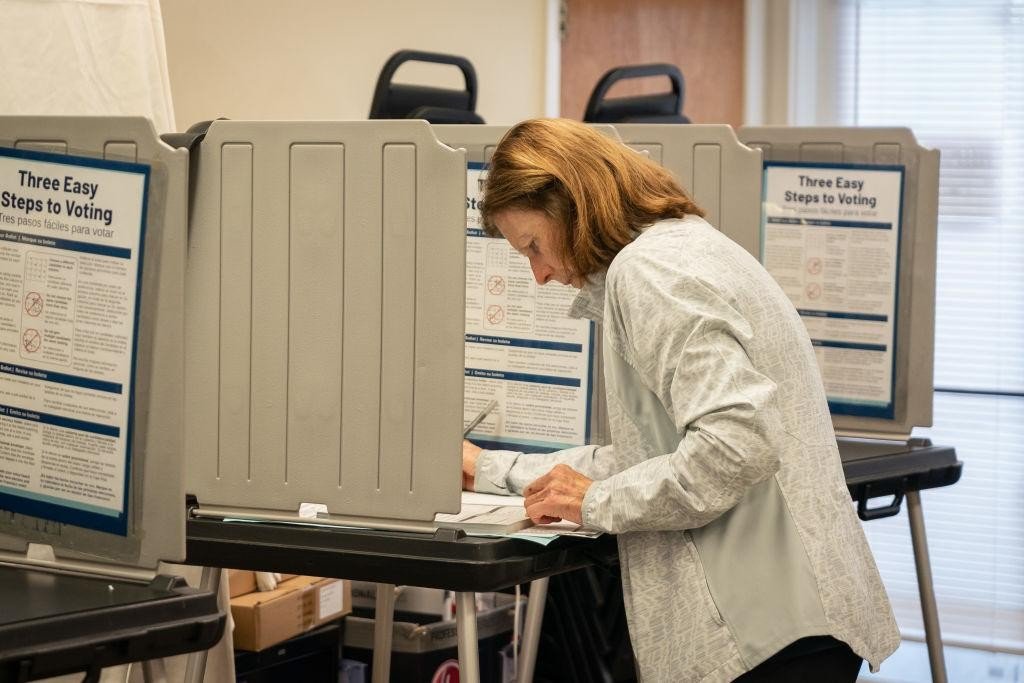

WASHINGTON — On November 3, American voters will cast ballots in the 2026 midterm elections, a contest that will determine whether Republicans retain their grip on Congress or Democrats seize the power to check President Donald Trump’s final two years in office.
All 435 House seats and 35 of the 100 Senate seats are up for election, along with 36 governorships. Early voting has already begun in more than a dozen states, and the political environment is tilting sharply toward Democrats.
| House of Representatives | Senate |
| 435 members | 100 members |
| Representatives/state based on state population | Two Senators/state |
| 2-year terms | 6-year staggered terms |
| All seats are up for election every 2 years | One-third (33 or 34) are up for election every 2 years |
What Are Midterms, and Why Do They Matter?
Midterms are a face-off between two major parties – Democratic and Republican. A Midterm Elections is a general election that take place approximately halfway through a president’s four-year term. This year, the stakes are especially high. Republicans currently hold a single-seat majority in the House and a six-seat edge in the Senate.
- If Democrats flip either chamber, they gain subpoena power, the ability to block legislation, and the platform to investigate the administration—potentially even pursuing impeachment.
- The party represented by the President hopes to gain majorities in both the Senate and the House of Representatives in the midterms
House and Senate Races Set Up a High-Stakes Battle for Congress
The Midterm Election of 2026 held in November are crucial, as everyone set their eyes on election. The Democrats will aim to flip the House of Representatives back to their control, and they will also challenge the Republicans in a number of Senate races.
The battle for the House: Democrats sees an opportunity to capitalize from voter concerns about affordability and the federal government’s direction. House Democratic Leader Hakeem Jeffries has running the campaigned nationwide to promote his party as the preferred solution to the mounting costs of living. Recent stories by the Associated Press and Fortune magazine detail his efforts to bolster Democratic candidates around the country.
The outcome will depend greatly on competitive congressional districts, where local issues and candidate performances will have an impact on the results alongside national political trends. The exact number of vulnerable seats should be assessed using the latest district ratings from The Cook Political Report.
Four Senate races to watch: In Ohio, Republican Senator Jon Husted is up against former Democratic senator Sherrod Brown in a closely contested race. The debate over data-center expansion and the accompanying tax incentives dominates the campaign, along with the broader economic issues.
Texas has a closely fought Senate race, too, between Democrat James Talarico and Republican Ken Paxton. The Cook Political Report classified the race as a toss-up in August, but voters should check the latest election ratings and polls.
In Kansas, Republican Sen. Roger Marshall faces Democratic challenger Adam Hamilton.Ballotpedia reported on October 20 that Cook rated the contest a toss-up.Economic pressures affecting farmers, including fuel and fertilizer costs, are among the factors highlighted in the race analysis.
Maine is also drawing attention as Republican Sen. Susan Collins seeks reelection against Democrat Troy Jackson.Her campaign faces scrutiny over her voting record, relationship with President Donald Trump and ability to maintain support in a state that voted against him in 2024.
What the results could mean The Senate contest is particularly challenging for Democrats because they need to pick up at least four seats in order to gain a majority in the chamber. Democrats are likely to do best if they win close races in which the opposition candidate is a Republican. A Democratic majority in the House would mean that the party controls both chambers of Congress and could force through its legislative agenda.
With the election day approaching, voters’ concerns about the economy and personal finances will be paramount, but voters’ thoughts will also turn to the candidates and the political environment in which they will operate. The final vote distribution will be decisive for voters in closely contested districts and states.
Can Midterms Affect the Presidency?
Absolutely—and that is the subtext of this entire election.
Trump has spent his second term governing with Republican majorities in both chambers, largely free of congressional pushback. If Democrats win one or both chambers, that dynamic ends abruptly. Investigations into alleged corruption, stalled legislative priorities, and a possible third impeachment effort would define his remaining time in office.
Trump himself has signaled a combative posture. “They’ll probably go after me, and I’ll go after them,” he told Time Magazine. Analysts expect him to remain “unrelentingly active” on trade and foreign policy, potentially resuming military action against Iran after the election.
There is also the question of whether he would accept the results. A Washington Post-ABC-Ipsos poll found that 7 in 10 Americans doubt Trump would accept Republican losses, including 36% of Republicans.
Republican Confidence and Trump’s Ratings
One of the few bright spots for Republicans is confidence in the election process itself. According to a Pew Research Center poll, 73% of Republican voters now say they expect the midterms to be well-run—slightly higher than the 72% of Democratic voters who say the same. This is the first time Republican confidence has edged above Democrats’ since 2018, a shift that followed Trump’s return to the White House.
A Reuters / Ipsos poll released this week put Trump’s approval rating at just 31%, the lowest of his entire presidency and the lowest for any president this close to a midterm since Harry Truman in 1946. In generic congressional ballot, Democrats led Republicans 47% to 35% a 12-point gap in the widest margin in favor of the party of the president.
The economy remains the cornerstone. 68% of Americans disapprove of Trump’s economic performance, and 68% disapprove of Trump’s handling of inflation. Gas prices have skyrocketed in the U.S. after the U.S. strike on Iran in February, with the CPI for September rising 3.7% year-over-year and gasoline prices soaring by 9.1% from the previous month.
For Republicans, the midterms have become a defensive operation. For Democrats, they represent the first real opportunity to constrain a president who has governed largely unchecked.
The only certainty, as one analyst put it, is that the result will be decided by a few thousand votes in a handful of states—and that Trump’s last election may be the one that defines his legacy.




2 Responses