
Introduction
One of the most important economic questions to answer for any business leader, investor, or consumer is that do interest rates drop during a recession? The short answer is generally yes but relying on that simple rule of thumb can be a costly mistake. But the reality is far more complex. The Federal Reserve will usually cut interest rates to boost an economy that is falling, the extent, depth and timing of the rate cuts will vary greatly depending on the unique circumstances of each downturn. For businesses mapping out strategy and individuals who are planning major financial decisions, understanding the mechanics behind these decisions why this happens will help you as a business to plan your strategy and as an individual to make major financial decisions. This article breaks down the historical patterns, the economic theory, and the practical implications you need to know.
Understanding Recession
A recession can be defined as a significant decline in economic activity that lasts for a continuous period usually lasting more than a few months. A recession is a prolonged period of negative economic growth in a country. In the United States, the National Bureau of Economic Research (NBER) has an official method to measure when a recession has occurred. They look at several factors such as real GDP, real income, employment, industrial production and wholesale/retail sales. As a result, during a recession period the consumer spending typically gets lower, unemployment rises, and business investment contracts, creating a self-reinforcing cycle of economic stagnation.
Overview of Interest Rates
Interest rates is the cost to borrow an amount of money (as a percentage). Although the Federal Reserve doesn’t set these rates directly, they have an influence over them by controlling the federal funds rate. This is the rate at which banks lend out their excess reserves to each other overnight. Changes in this benchmark rate ripple through the economy, affecting everything from mortgage rates and auto loans to corporate bond yields and savings account returns. The Federal Reserve has a dual mandate to “maximize employment” and “price stability” which will influence decisions to increase, decrease or leave rates the same.
Importance of the Topic
The question of whether rates fall during a recession matters for everyone. For consumers, lower rates can mean cheaper mortgages and more affordable credit card debt. For investors, rate cuts can signal shifts in equity valuations, bond yields, and currency dynamics. For businesses, the cost of capital directly influences expansion plans and hiring decisions. Misunderstanding the relationship between recessions and rates can lead to poor financial timing and suboptimal investment outcomes.
What Happens to Interest Rates During a Recession?
Historical Perspective
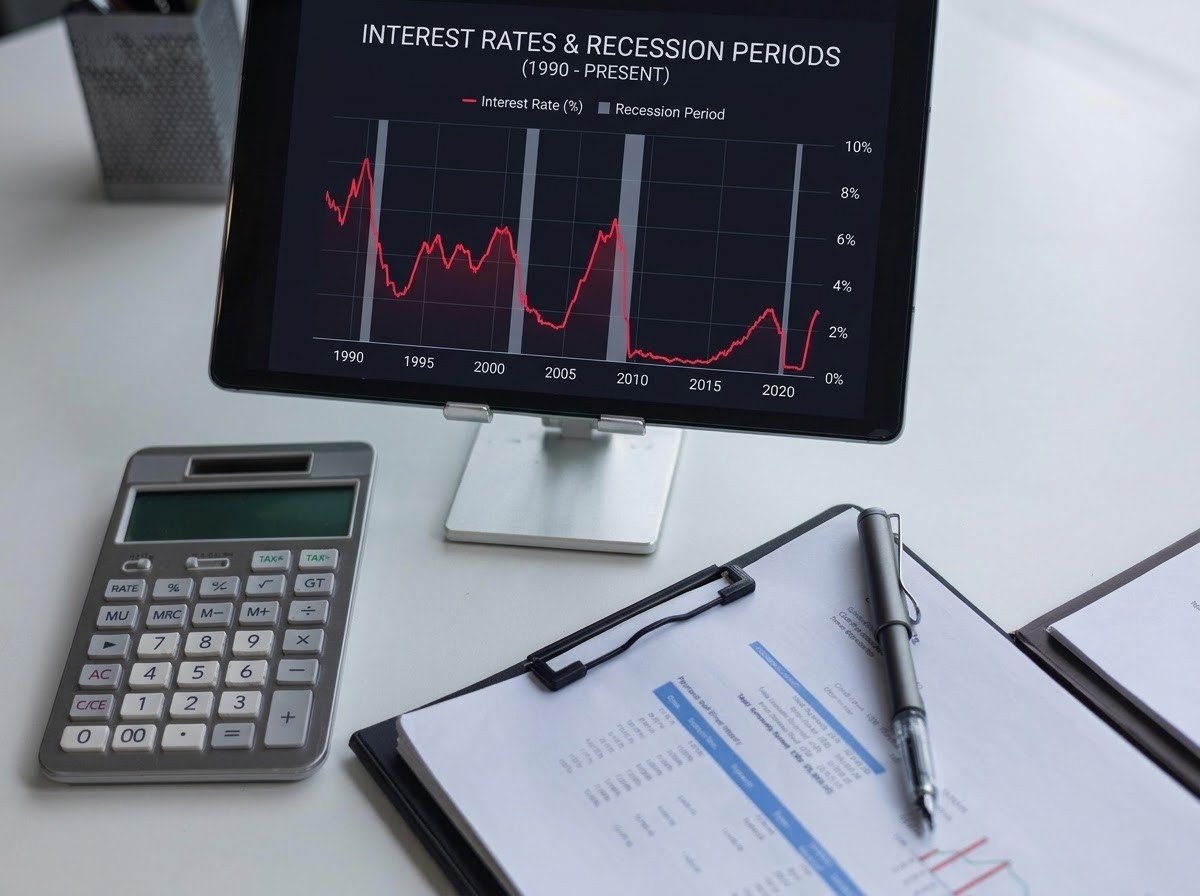
Historically there exists a clear trend towards falling nominal interest rates in periods of recession. The interbank interest rate tends to fall by approximately 0.7% (70 basis points) on average in OECD countries compared to many non-OECD countries during periods of recession.
The expectation hypothesis of the term structure of interest rates shows that when market participants anticipate a downturn, they also anticipate that the central bank will cut the policy rate in the future to provide monetary accommodation This means that short term yields are expected to fall, therefore long term yields will fall too. This often results in the yield curve flattening/inverting before a recession occurs.
Economic Theory behind Interest Rates and Recession
The theoretical framework governing this relationship is countercyclical monetary policy. In times of economic downturn, central banks will attempt to minimize it by cutting short term nominal rates. The Taylor Rule, can be referred to as a policy guideline, which shows how much the central bank should change the federal funds rate based on how much inflation deviates away from its target level and how much output deviates away from potential output. In periods of recession, where unemployment will increase and inflation will typically fall, the Taylor Rule will generally show rates should be cut.
A critical complication arises when policy rates approach the zero lower bound (ZLB). When nominal rates hit zero, conventional monetary policy loses its traction, forcing central banks to deploy unconventional tools such as quantitative easing and forward guidance.
Factors Influencing Interest Rates During Recession
Monetary Policy and Federal Reserve Actions
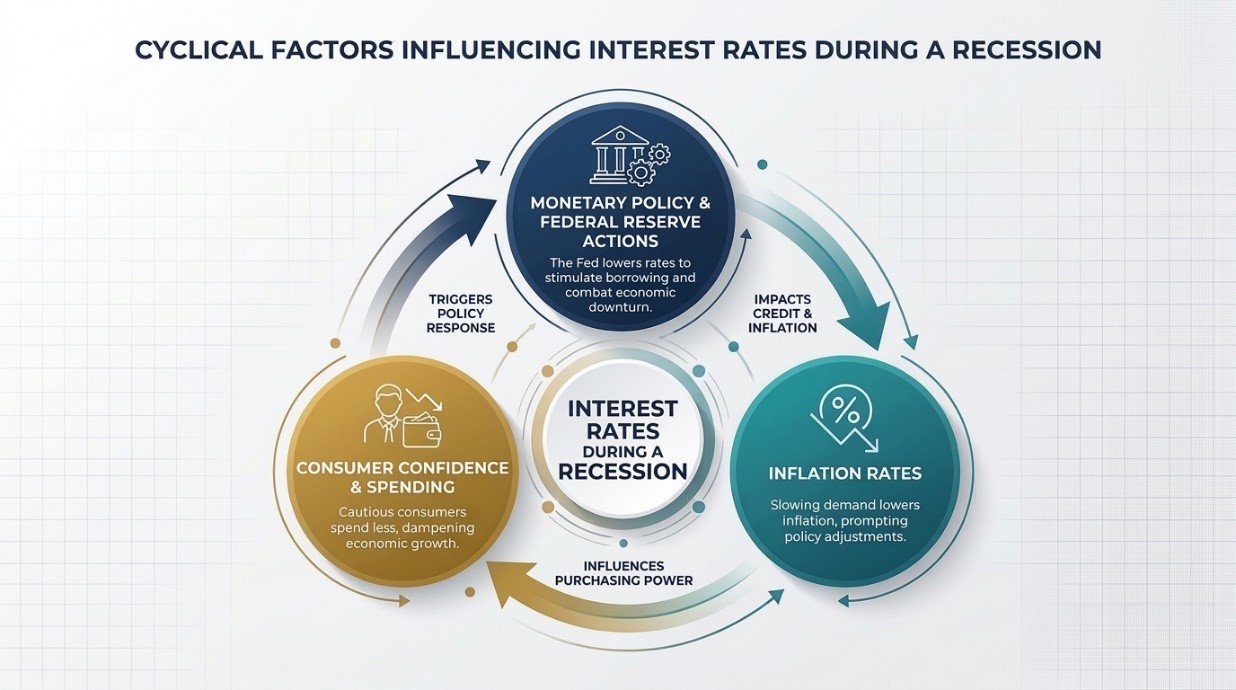
The Federal Reserve’s response is the single most powerful determinant of rate movements. The federal funds rate has historically exhibited a cyclical pattern rising during inflationary periods and falling during recessions reflecting the Fed’s dual mandate to manage price stability and support economic growth. However, the Fed does not always act with the same speed or conviction.
Inflation Rates
Inflation is the critical variable that can override recession rate cut logic. If inflation remains high during an economic slowdown a condition known as stagflation the Fed faces an impossible choice: cutting the interest rates to prevent a recession risks, whereas higher interest rates to tackle prices will cause a further slowdown. In such environments, the confidence-to-yield relationship can invert, with yields rising even as sentiment deteriorates because markets demand inflation compensation.
Consumer Confidence and Spending
Slumping consumer confidence can pull government yields lower when it credibly signals weaker growth and a higher probability of easing from the central bank. The 5year yield is a reliable indicator of changes to policy expectations however the 10 year requires confirmation through job, spending and inflation data before moving lower. If consumer confidence is weak and causes lower retail demand, employment and wage growth, then the market often will price in an earlier easing.
What This Means for Your Business
Understanding the nuanced relationship between recessions and interest rates is not just an academic exercise, it has direct, actionable implications for business strategy. Here are what leaders should keep in mind.
- Do not assume low rates are guaranteed:
According to the historical events gives signs that rates will fall, if we see a situation of stagflation (1981-1982), the Central Bank may feel forced to raise rates. If businesses are expecting significant rate cuts when planning their 2026 and 2027 budgets on the assumptions, then they may not have to consider the risk of higher inflation. Stress-test your capital expenditure plans against a “higher-for-longer” rate scenario.
- Refinancing opportunities may arise but timing is everything:
For companies who are carrying variable rate debt or facing upcoming maturities, a rate cut driven by the recession situation can be a welcome relief. However, as seen in the 1990 recession demonstrated, the Fed doesn’t always move fast enough. Be proactive and review your yield curve and watch the Feds communications. Having refinancing documents ready will help you move quickly when the opportunity comes.
- Credit standards will tighten, even as rates fall:
Lower benchmark rates don’t necessarily mean increased access to capital. Lenders will often become more restrictive during economic downturns meaning businesses, particularly smaller ones can struggle to get access to loans. Companies with weaker balance sheets should therefore look to strengthen their liquidity and bank relationships to avoid this issue.
- Consumer demand shifts create both risks and openings:
While lower interest rates can increase consumer borrowing and spending there is also an indicator showing that the economy is struggling. Companies in non-essential industries (e.g. travel, hospitality, big-ticket retail) should prepare for volatile demand. However, companies in refinance driven industries (e.g. residential property and automotive) could benefit from an increase in activity.
- Strategic hiring and investment require a longer view:
The Fed’s rate decisions affect the cost of capital, but they do not change the underlying fundamentals of your business. Companies that use a recession as an opportunity to invest in talent, technology, and market position, while competitors retrench often emerge stronger. The key is to align investment decisions with a realistic assessment of the rate environment, not a hopeful one.
Conclusion
The truth behind “do interest rates drop during a recession?” is that they usually do, but not always and not immediately, and also the amount doesn’t remain same. The Federal Reserve’s countercyclical mandate drives it to lower rates to stimulate growth, but its actions are conditioned by inflation, the zero lower bound, consumer confidence, and the unique structural features of each downturn. Historical case studies from 1981 to 2020 illustrate that while the direction of rate movements is generally predictable, the pace and magnitude are anything but.
Final Thoughts on Interest Rates in Recession
As of early 2026, the Federal Reserve faces a particularly delicate balancing act. With the benchmark rate sitting between 3.50% and 3.75% following three cuts in late 2025, policymakers are caught between the risk of resurgent inflation and the threat of a slowing labor market. Markets are pricing in additional cuts, but the path forward remains uncertain. For consumers, investors, and businesses alike, the key takeaway is clear: do not assume that a recession automatically means cheap money. Understanding the forces that shape central bank decisions—rather than relying on a simplified rule of thumb—is the surest way to navigate the economic cycles ahead