
Forget zero to 60. Tesla just proved the future does have flying cars.
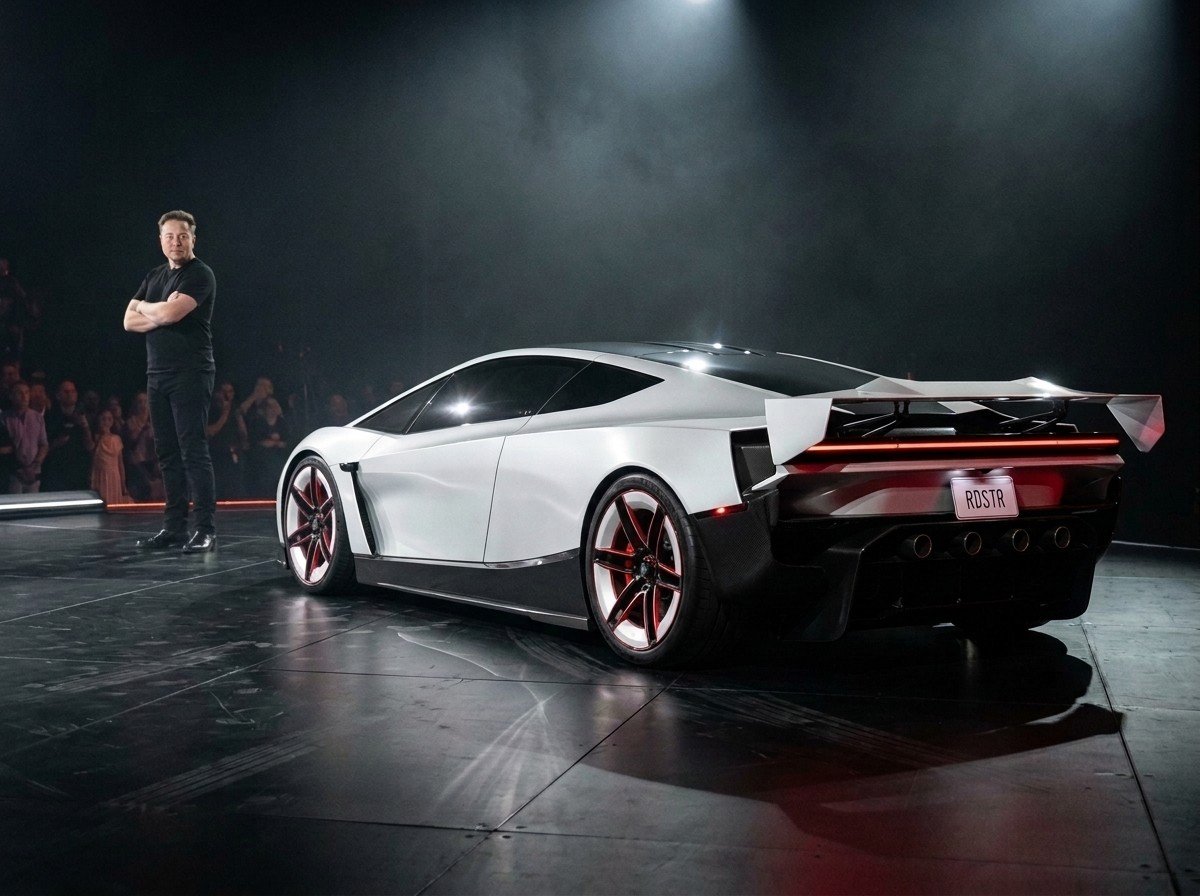
On October 15, 2026, at a SpaceX test facility in McGregor, Texas, Elon Musk unveiled a thing that the auto industry has been waiting to see from nearly a decade to see: A Tesla Roadster that doesn’t just drive but it lifts off the ground, spins in the mid-air, and lands on the ground like a spacecraft. The livestreamed event drew Tesla fans, people who’d made a fortune by holding on to a reservation, and the world’s media, as Musk said he wanted witnesses with Musk telling the crowd he witnessed “to prove that it’s not AI or SI.”
Musk said the Roadster was “the Roadster is not fully a safety optimized car”, but that “it would be an actual car that’s on the roads”.
Tesla Roadster Flying Car Features: What This Machine Can Actually Do
The redesigned Roadster is not a conventional sports car with a gimmick bolted on. It is a two-seat electric vehicle developed in collaboration with SpaceX, Tesla’s sibling rocket company, and it borrows technology you would normally associate with spacecraft rather than street cars.
The propulsion system is the headline. The car uses cold-gas thrusters and what Musk described as “ultra high-pressure air tanks” which produce thrust to lift and control. There are ten nozzles on board the vehicle, with rear-mounted main thrusters providing forward acceleration and smaller altitude-control units managing orientation in the air. he system is similar to the Reaction Control System used on the lunar module during the Apollo missions, said Musk
The suction system is what makes the stunts possible. A “multi-mode” fan-based suction mechanism underneath the car allows it to grip a steep ramp and drive upside down, defying gravity long enough to set up the aerial maneuvers that followed.
The performance numbers are extreme. With thrusters on board, Tesla claims the Roadster goes from 0 to 60 mph in less than a second and hits a top speed of over 230 mph. The driverless car then launched itself off a steel ramp and did a complete barrel roll in the air before landing on its wheels. It later jumped over a row of parked Teslas and a semi-truck.
There is a major catch. The fine print on Tesla’s reservation page states plainly: “Not approved for public road use.” Musk himself acknowledged uncertainty about legality, telling the crowd, “I’m not necessarily sure it’s legal in all jurisdictions.”
The Real Purpose Behind Tesla’s Flying Car—and What the Future Holds
Why did Tesla build this? The Roadster is not meant to be a mass-market product. Musk has previously called it a “small potato situation” financially. Its real function is symbolic and strategic. Tesla is positioning the Roadster as the “best of the last human-driven cars” a flagship that reminds the world what Tesla can engineer when it combines its electric vehicle platform with SpaceX’s rocket expertise. In an era when Tesla’s core business faces sales pressure and increasing competition, the flying Roadster is a statement of technological dominance.
Production is targeted for 2028, but skepticism is warranted. Musk has a long history of missing deadlines, and the Roadster itself was first promised with a 2020 delivery date after its 2017 prototype reveal. The current “Thrust” variant requires a $250,000 deposit, and Tesla has not announced final pricing for the 2028 release.
The future of flying cars will be determined by regulations as much as by technology. As of 2026, the Federal Aviation Administration has not certified any Tesla for flight, and a dual-use vehicle would require approval from both aviation and road-safety agencies, a process that typically takes years to complete. The market for flying cars is expected to grow from $315 billion in 2025 to nearly $458 billion in 2026, but the road from development to everyday use is a long one.
What could actually be accomplished? The Roadster’s brief leaps are not indicative of sustained flight. Experts say that a hybrid between road and aircraft tends to be a “poor performing aircraft and a poor performing vehicle,” due to conflicting weight and safety needs. The more realistic near future is the eVTOL aircraft, an electric vertical takeoff and landing vehicle, designed for the sole purpose of aerial travel, while the Roadster remains a high-performance novelty with limited practicality in terms of flight.
Nevertheless, the demonstration is significant. The flying car has long been a joke about a future that seems not to be coming, but Tesla has just shown that a street legal electric sports car can be made to levitate upon its own power. Whether this is the beginning of a transportation revolution or the end of a long line of expensive eddies is ultimately not for Texas to decide, but for regulators, engineers, and customers in the years to come.