
Introduction: Why Battery Energy Storage News Today Matters
The demand for the battery storage in 2026 is rising rapidly, Battery energy storage news today is defined by one clear signal: the world is expected to install 112GW of battery storage in 2026, a 48% increase over the previous year according to BloombergNEF. Analysts expect a further 41% increase to 158GW, laying the foundation for how future grids will balance supply and demand. This became the foundation of how the future grids are learning to balance the supply and demand for the battery energy saving.
So why are we storing energy, and what purpose does it serve?
The timing is the crucial factor as it depends on it, Solar panels generate Electricity when the sun rays are available as it produces electricity using the sunlight. People still need electricity all the time, during the night period, the heat waves or when the power grid is under pressure.
Battery energy storage can store the surplus renewable power in batteries and releases it when demand rises. It also replaces peak gas power plants, which provides backup during shortage of electricity, and helps businesses and homeowners manage their electricity costs.
Today’s battery energy storage news tells a story of acceleration and two specific breakthroughs are worth your attention.
1. The Sodium-Ion Commercialization Inflection Point
For years, sodium-ion batteries were treated as a backup chemistry useful in theory, but insufficient development for practical application. That theory is now fallen apart.
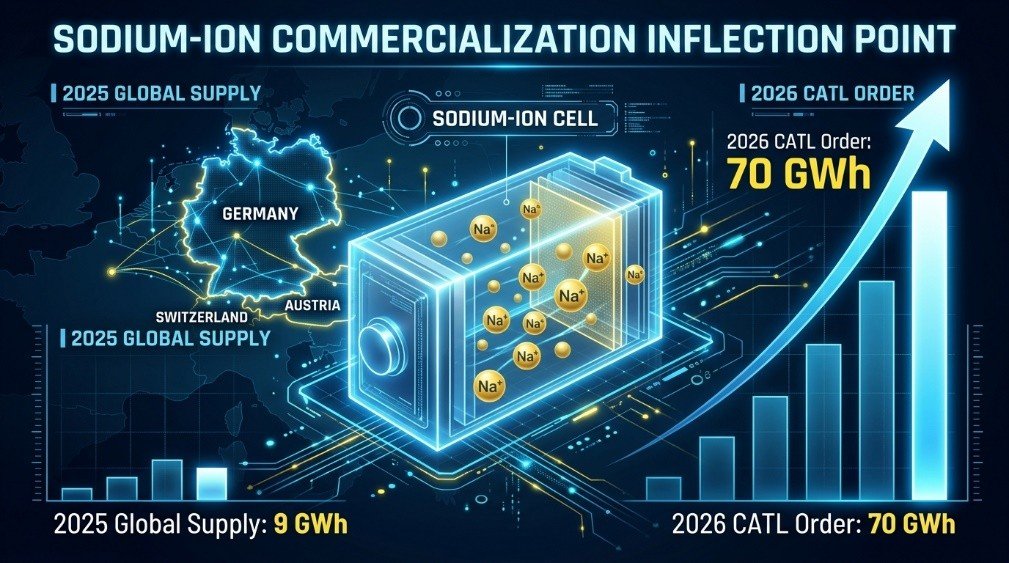
In October 2026, CATL, the world’s largest battery manufacturer, completed an order of 70 GWh sodium-ion battery in Europe. For comparison, the world’s total supply of sodium-ion batteries in 2025 was only 9 GWh. CATL’s order volume is now more than seven times higher than last year’s actual global shipment volume. CATL’s on-hand orders are now more than seven times last year’s actual global shipment.
The deal includes a partnership with German system integrator intuition to deploy sodium ion storage units in Germany, Austria and Switzerland with a target of up to 3GWh over the next five years. CATL will unveil the TENER sodium system in Munich in June 2026 and expects shipments to reach 1GWh this year, with international deliveries starting in June 2027.
What changed? The performance numbers are now competitive with lithium iron phosphate (LFP) systems. Intuition verified that round-trip efficiency has exceeded over 96.5%, cycle life exceeds 15,000 cycles in high-temperature environments, and was over 90% at low temperature. That last figure is crucial. For storage installations in Northern Europe, Canada, and northern China, lithium batteries could never completely solve the problem with cold temperatures. Sodium-ion batteries can: at -20 degrees Celsius, the battery can still discharge more than 90% of its electricity.
CATL expects sodium-ion costs to reach parity with LFP by the end of 2026 and to keep declining with growing manufacturing scale. It is not laboratory chemistry but an innovation in renewable energy storage that marks the beginning of diversified battery chemistries.
2. Home Batteries Are Becoming Grid Assets
The second major shift in battery storage news is the transformation of home batteries from backup devices into coordinated grid resources.
On October 6, 2026, Tesla Powerwall owners across California dispatched a record 745 MW to the grid during a prolonged heat wave. More than 85,000 Power wall owners sent over 600 MW, the bulk of a combined dispatch that Sun run announced. That’s 28% more than the previous record set less than a month earlier and bigger than most gas peaker plants in the state.
This is home energy storage news at its most consequential. Virtual power plants (VPPs) aggregate thousands of residential batteries into a single dispatchable resource. Sun run now operates more than 120,000 residential batteries and expects its distributed power plant operations to generate about $40 million in revenue this year.
For homeowners, this means a battery isn’t just backup power anymore but it’s a revenue-generating asset.
3. Battery Storage is Scaling Fast, Why?
Battery storage is scaling fast because it is effected by these three forces that are converging: cost parity, demand growth, and policy support.
Four-hour battery storage now becoming cheaper than open-cycle gas turbines across all 43 markets. In the Middle East and Africa, four-hour BESS costs are projected to reach $120/MWh in 2026. In China, grid-scale storage costs are more than 55% lower than the Asia-Pacific regional average, due to manufacturing scale effects.
Data centers, AI infrastructure and electrification are becoming the main factor for the increase in the demand for battery storage. The U.S. annual energy storage installations are set to rise from 51 GWh in 2026 to 70 GWh next year, then to over 110 GWh by 2030.
Tips for homeowners: If you have a battery installed in homes or are planning to buying one, should check first whether your utility offers a VPP program. Many of the programs like Tesla’s in California pay homeowners for providing grid support during the peak demand.
Tips for entrepreneurs: Energy costs are a business expenditure, and storage is becoming an emerging business tool. Commercial battery systems helps to reduce demand charges, provide backup during outages, and participate in grid service markets. At four-hours of storage, battery systems are cheaper than gas peakers in 43 global electricity markets, so it’s an economic opportunity for large electricity users.
Conclusion:
The energy storage news today is not just about growth. It is about a market that has reached maturity, with multiple chemistries, multiple business models, and multiple geographies all seeing expansion at the same time. Battery storage is scaling faster whether you’re a homeowner watching your utility bill and wanting to reduce utility costs. Or an entrepreneur looking to make money off of the energy storage space will be affected by this trend.